
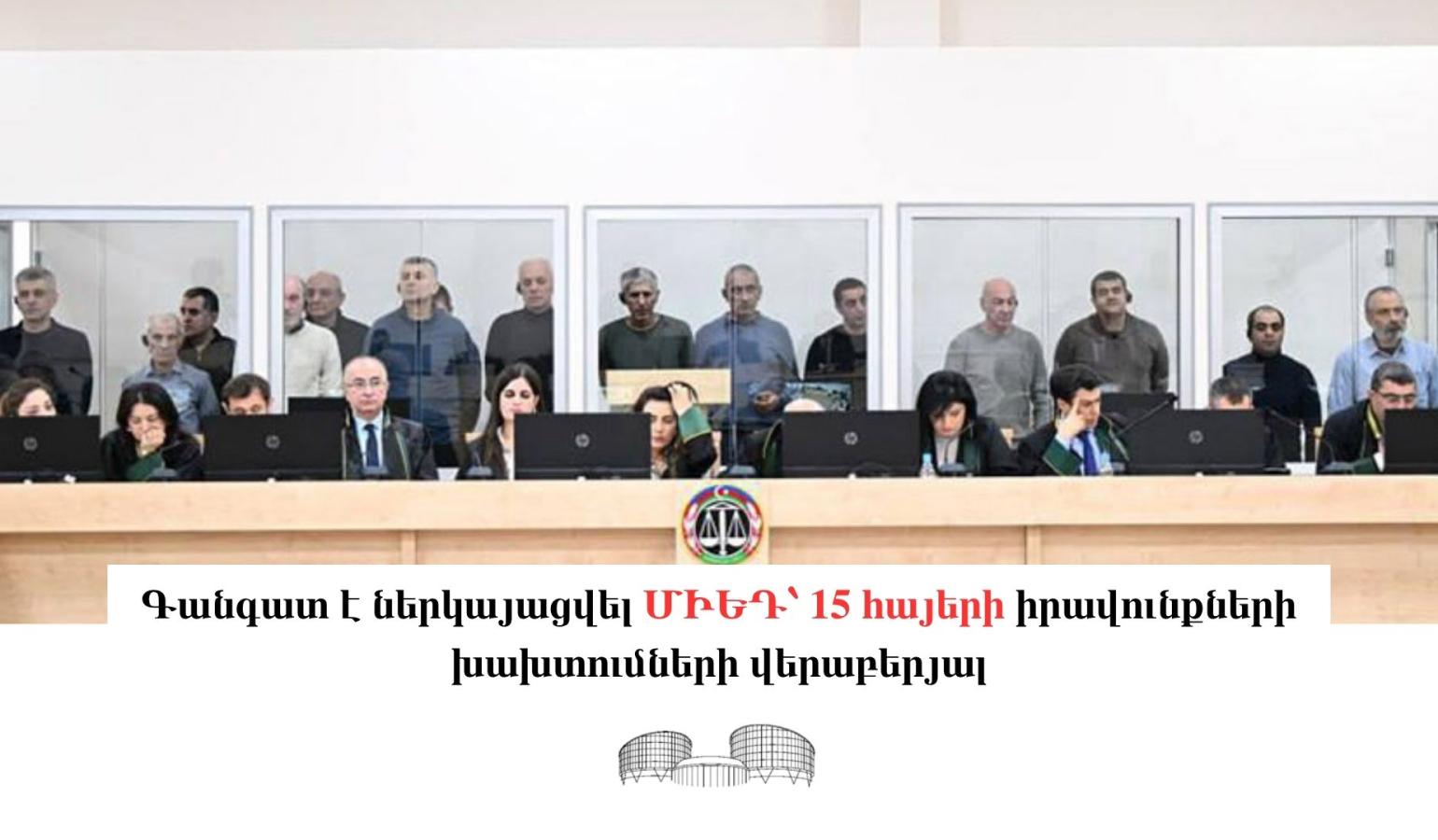
On August 21, 2026, human rights defender and representative of Armenian prisoners of war before the ECtHR, Siranush Sahakyan filed a group complaint with the European Court of Human Rights concerning violations of the rights of Armenian prisoners of war held in detention in Azerbaijan. The complaint was filed concerning former Presidents of the Republic of Artsakh Bako Sahakyan, Arkadi Ghukasyan, and Arayik Harutyunyan, former President of the National Assembly Davit Ishkhanyan, former Minister of Foreign Affairs Davit Babayan, Major General and former senior military commander Davit Manukyan, Lieutenant General and former Minister of Defense Levon Mnatsakanyan, as well as Madat Babayan, Garik Martirosyan, Levon Balayan, Davit Allahverdyan, Vasili Beglaryan, Erik Ghazaryan, Gurgen Stepanyan, and Melikset Pashayan.
The complaint raises the issue of the incompatibility of the “trials” conducted by Azerbaijan against 15 Armenians with the right to a fair trial guaranteed by Article 6 of the Convention. The “trials” conducted before the Baku Military Court were fictitious and predetermined in nature, lacking the fundamental guarantee of an independent and impartial examination. At the same time, the Military Court did not have the requisite jurisdiction to hear cases concerning civilians and render judicial acts.
At the same time, before and during the trial, high-ranking Azerbaijani officials, including President Ilham Aliyev, publicly presented the defendants as “terrorists,” “war criminals,” and “separatists” before a judicial act determining their guilt had been rendered. The same approach was also reflected in publications by Azerbaijani state and pro-government media, where the charges brought were presented as established facts. Thus, the public and official position regarding guilt was formed before the conclusion of the judicial proceedings, undermining the presumption of innocence.
The complaint also raises issues concerning violations of the right to defense. In particular, most of the case materials, comprising 422 volumes and approximately 105,000 pages, were not available with adequate translations. The defense’s requests to have access to the case materials, obtain translations, have sufficient time and facilities, and communicate effectively with their clients were rejected or unduly delayed.
Violations of the right to defense continued also at the stage of the provision of the “judgment” and its appeal. The prisoners were given the opportunity only to read the “judgment,” which did not bear an official seal or any other authentication confirming its authenticity. Under these circumstances, it was impossible to verify whether the text presented for reading was the complete and final version of the “judgment,” and its immutability was likewise not guaranteed. At the same time, copies of the “judgment” were provided neither to the prisoners’ families nor to the lawyers appointed by Azerbaijan within the framework of free legal aid; the latter were given access only to individual excerpts. Despite these evident restrictions on the right to defense, on August 6, 2026, the appellate court left the “judgment” and the sentences imposed thereby unchanged, exposing before the international community the systemic ineffectiveness of Azerbaijan’s domestic legal mechanisms in ensuring the protection of the rights of ethnic Armenians.
The complaint also raises the issue of a violation of the principle guaranteed by Article 7 of the Convention, namely, that there can be no crime or punishment without law. The participation of the military-political leadership of Artsakh and the other prisoners in military operations or the carrying of weapons, in itself, cannot be equated with terrorist or other criminal activity and serve as a basis for criminal liability without establishing the specific criminal act attributed to each individual and individual guilt.
A possible judgment of the ECtHR may have both legal and political consequences. At the international judicial level, it will call into question the legality and legal value of the trial conducted and the “judgment” rendered as a result thereof, giving rise to an immediate obligation to eliminate the consequences of the violations of law.
The international judicial recognition of politically motivated persecutions substantially neutralizes Azerbaijan’s attempt to confer legal credibility to its own official narrative concerning the conflict through sham domestic judicial proceedings. In that case, the “judgment” will lose its significance as a document reflecting Azerbaijan’s unilateral historical and political interpretation of the conflict, limiting the use of that “judgment” on international political and diplomatic platforms.
The complaint was filed within the framework of public activities, in cooperation with the “International and Comparative Law Center” and the “Armenian Legal Center for Justice and Human Rights.”