
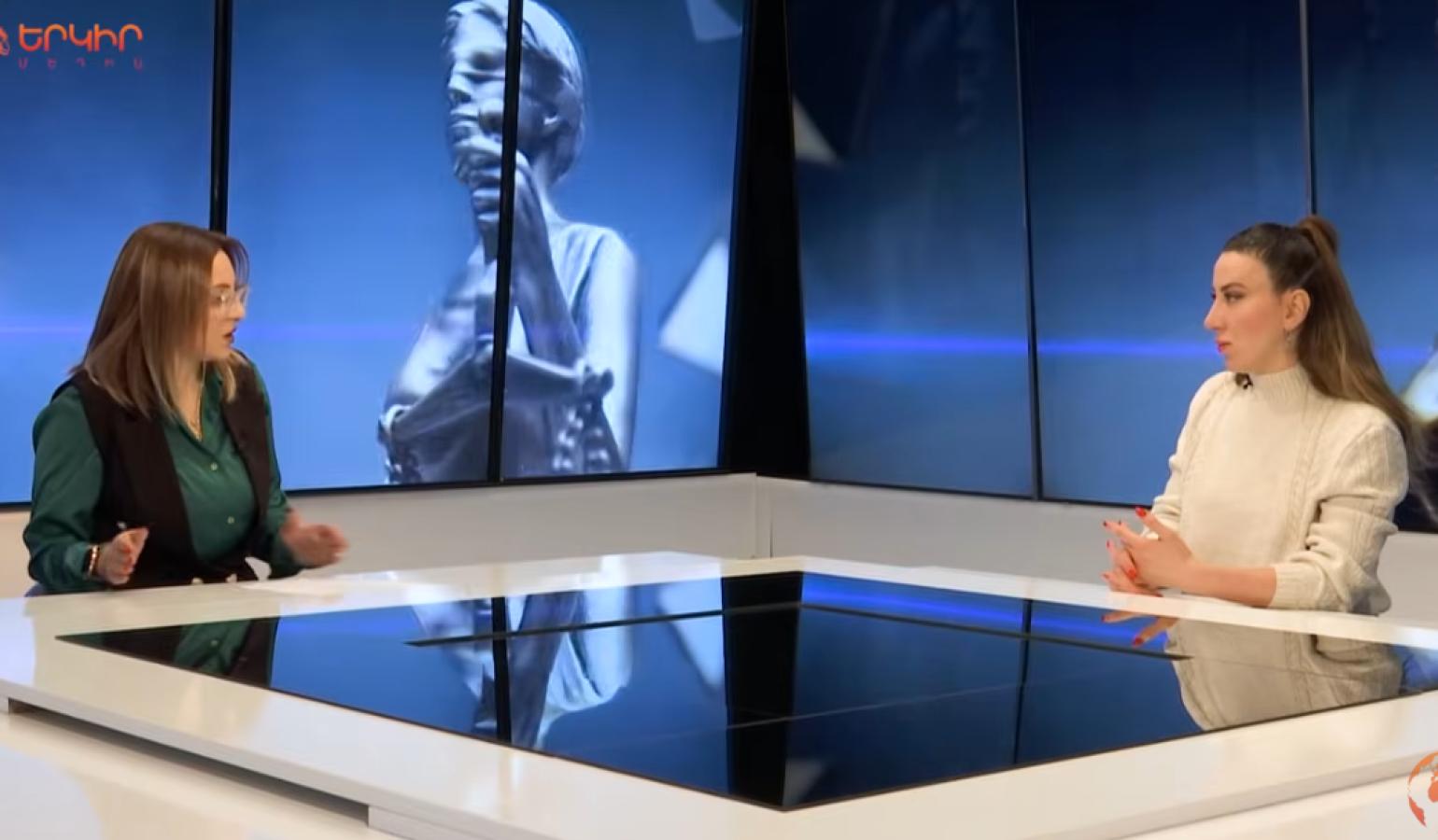
Siranush Sahakyan, director of the “Center for International and Comparative Law,” in an interview given to the “Legal Clinic” program of Yerkir Media TV, clarified the issue related to the legal status of persons returned from Azerbaijani captivity. According to the human rights defender, this issue is regulated by international law: taking into account that these persons were deprived of liberty as a result of the conflict, in classical terms they are considered captives. International humanitarian law differentiates between civilians and military personnel or militarized persons, and this is one of the most fundamental principles of humanitarian law. “With regard to the repatriated persons, we can clearly state that they were civilians, therefore, in classical terms they were captives, not prisoners of war. They did not take up arms during the conflict and did not carry out militarized actions against the opposing side,” said Sahakyan.
With regard to the returned Armenian captives, there were criminal proceedings against them in Azerbaijani courts. The interviewer asked what legal status had changed in the Azerbaijani court as a result of which they were returned. According to Sahakyan, from the perspective of domestic perceptions there has been no change in the situation: under Azerbaijani legislation, they are considered convicted persons with imposed sentences, moreover severe ones, in the form of long-term imprisonment. “If the process had been purely legal, they could have been transferred to the Republic of Armenia for the purpose of serving their sentences. But the fact that the release of these individuals was carried out through such a process once again proves that their detention in Azerbaijan and their participation in unlawful trials had a more political nature and did not fit within the logic of legal proceedings. International humanitarian law, of course, also allows for trials of captives and prisoners of war, but only for certain limited offenses, for example, they must have committed crimes of an international nature, otherwise, humanitarian law prohibits imposing criminal liability solely on the basis of status. That is, being a citizen of a party to the conflict or, as a result, being present in a conflict zone cannot justify the implementation of punitive actions against these individuals on the basis of their ethnic affiliation,” said the human rights defender.
Speaking about the transfer by Armenia of two Syrian mercenaries, the human rights defender expressed concern about the lack of transparency in the process. Is there an international legal basis within which Armenia could have cooperated with the Syrian government, as a result of which the transfer of those mercenaries to the Syrian authorities was possible? According to Siranush Sahakyan, this question should have been answered first. Armenia has multilateral international treaties related to extradition, to which, however, Syria is not a party. “That is, first it was necessary to clarify whether there was a legal basis regulating extradition or not. If such a basis existed, Armenia could have transferred them to the Syrian authorities, and the pardon could have been granted precisely in Syria. We have a precedent for this in the Safarov case, when Hungary transferred him to Azerbaijan for the purpose of serving his sentence, but Azerbaijan granted him a pardon on the same day. If the individuals were initially to be released in Armenia, then there should have been a legal basis for that - a releasing act in the form of a pardon. I cannot claim whether such a document exists or not, but I can simply state that the process was not transparent or public. If such acts had been adopted, at the very least the public should have been informed about them,” said Sahakyan.
How will this precedent affect the fate of other Armenian hostages held in Azerbaijan? According to Sahakyan, political agreements dominate over legal solutions. “We must accept that the political factor is significant in the issue of the return of captives, and the return of the military-political leadership of Artsakh will also be conditioned by this. The positive aspect is that, in fact, through a deal it is possible to achieve their release, and even Azerbaijani judicial acts are not an obstacle in this matter. If appropriate agreements are reached, sham trials cannot ensure life imprisonment of the military-political leaders in Azerbaijani prisons. But the political component is vulnerable, because the principles of justice and law may become the subject of disproportionate bargaining. In my assessment, with the involvement of international partners, this issue is solvable. Any international actor that declares an intention to ensure the peace process has a political and moral responsibility to also ensure the release of the captives held in Baku,” said Sahakyan.
Currently, 19 captives are being held in Azerbaijan, including the military-political leaders of Artsakh. The trials have already concluded, and Siranush Sahakyan expects that the verdicts will be published in early February. The human rights defender noted: “With regard to seven military-political leaders, we predict life imprisonment or 20 years of imprisonment. We see certain delays in the case of Ruben Vardanyan. In my interpretation, Azerbaijan will first publish the verdict in the case of the 15, after which the court will hold several formal hearings in Vardanyan’s case and will proceed to publish a life imprisonment verdict with respect to Ruben Vardanyan as well.”
After that, the most pressing issue will be the international delegitimization of these trials, the shortest path of which is to submit an application to the European Court of Human Rights on the basis of the right to a fair trial, regarding the violations that occurred during these proceedings. In this direction, the “Center for International and Comparative Law” is already carrying out certain preparatory work.