
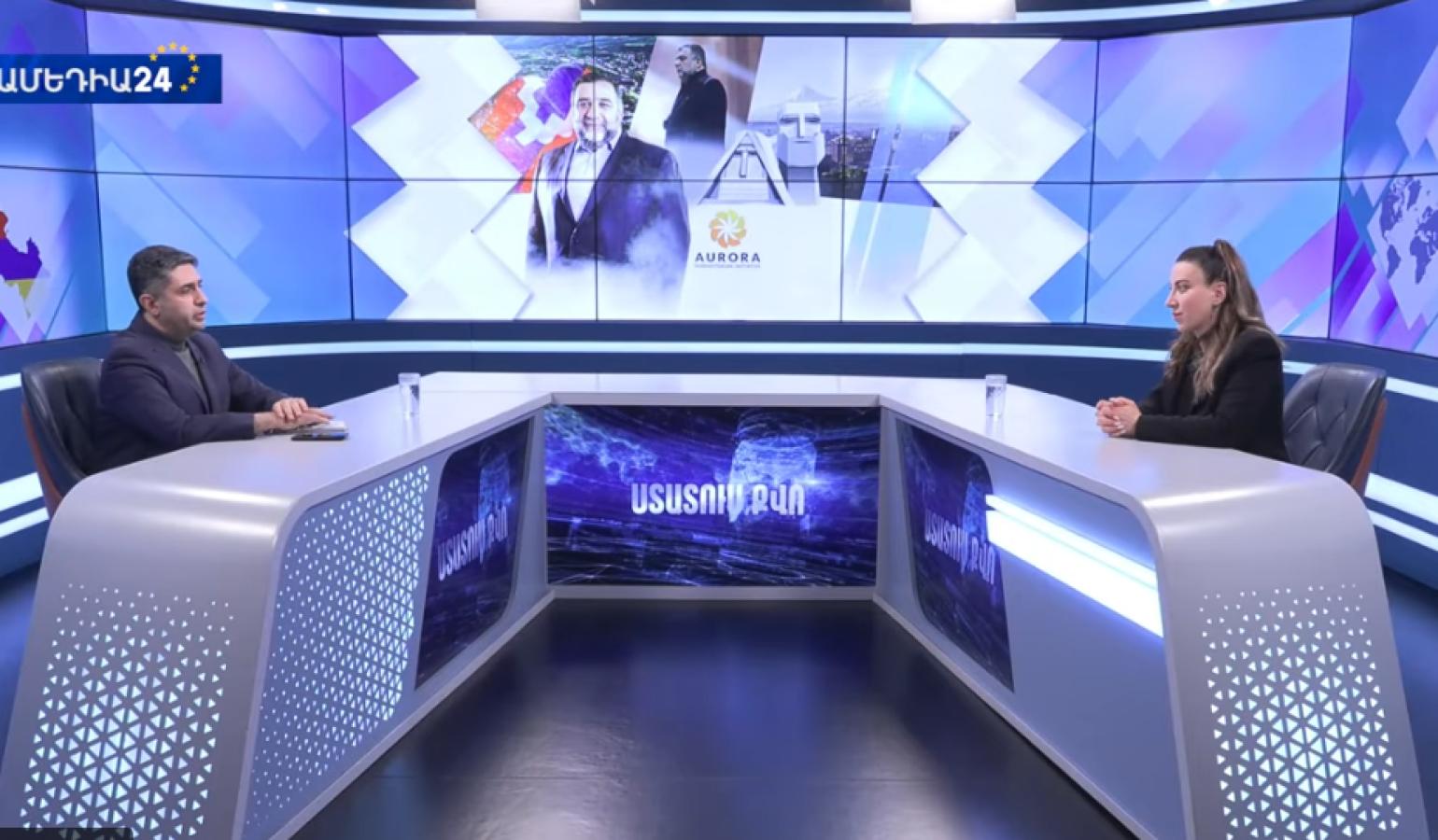
Siranush Sahakyan, Director of the “International and Comparative Law Center” and representative of the interests of Armenian prisoners of war at the European Court of Human Rights, answered the questions of political scientist Gevorg Melikyan within the framework of the “Status Quo” program on euromedia.am. Speaking about the trials ended in Baku, Sahakyan noted that their entire course had been politicized, and that in Baku the right to self-determination of Artsakh had symbolically been condemned.
“The right to self-determination of Artsakh is not rejected by international law. Moreover, the unilateral declaration of independence by Artsakh has not been recognized as an act violating international law, and in international practice we likewise do not have a case where leaders who have exercised the right to self-determination are subjected to criminal liability for terrorism or war crimes,” said Sahakyan.
Referring to the verdict against Ruben Vardanyan, Sahakyan noted that the more than 400 episodes attributed to Vardanyan, including the qualification of charitable initiatives as criminal activity, testify to the fabricated nature of the charges. Actions from the 1990s form the basis of Ruben Vardanyan’s verdict and have been imputed to him. “This provides grounds to assert that we are dealing not with individualized responsibility, but with the phenomenon of placing collective responsibility on specific individuals,” said Sahakyan.
According to Sahakyan, the statements of Hikmet Hajiyev, assistant to the President of Azerbaijan Ilham Aliyev, which linked the verdicts to the events of Khojaly, are a “self-confession” that these tribunals lack independence and are guided by principles of revenge and political expediency.
Addressing the issue of the return of prisoners, Sahakyan noted that Azerbaijan uses it as a bargaining object and a lever to extract ever new concessions from the Armenian side. However, according to her, history has shown that even the most hardline dictators submit to external influences when the issue becomes part of an international political deal. Sahakyan believes that the leaders of both countries are not consistent in their public statements. For example, in 2021 Aliyev had declared that the boys captured in Khtsaberd were terrorists, and that “the Azerbaijani side has handed over all prisoners to the Armenian side, and those who have not been returned are not prisoners and will not be returned to Armenia.” “Nevertheless, we saw that in parallel with developments, solutions matured, and as a result the Azerbaijani side released servicemen who had been labeled as ‘terrorists’ by their leader. I believe that the negotiations underway around peace and their actors can generate such political and moral pressure that, within that context, the release of prisoners becomes possible. Ultimately, in this process the Armenian side is making unimaginable concessions, and the international community, being the sponsor of this process, must be able to preserve its credibility within Armenian society, and this is possible exclusively through resolving humanitarian issues,” said Sahakyan.
One segment of the interview concerned the citizenship of Artsakh residents and the legal significance of passports of the Republic of Armenia. Siranush Sahakyan clarified: “The entire essence of citizenship is also a political bond with the state. If we have a legal and social bond with the state but do not have a political bond, there cannot be full citizenship. Meanwhile, Artsakh residents have not been able to exercise in Armenia the primary political right to vote and to be elected. In my assessment, without the exercise of that scope of political rights, there could not be real citizenship.” At the same time, the human rights defender also noted that in external relations, citizens of Artsakh have always been perceived and treated as equal to citizens of the Republic of Armenia, and Armenia bears full responsibility for their diplomatic and legal protection.