
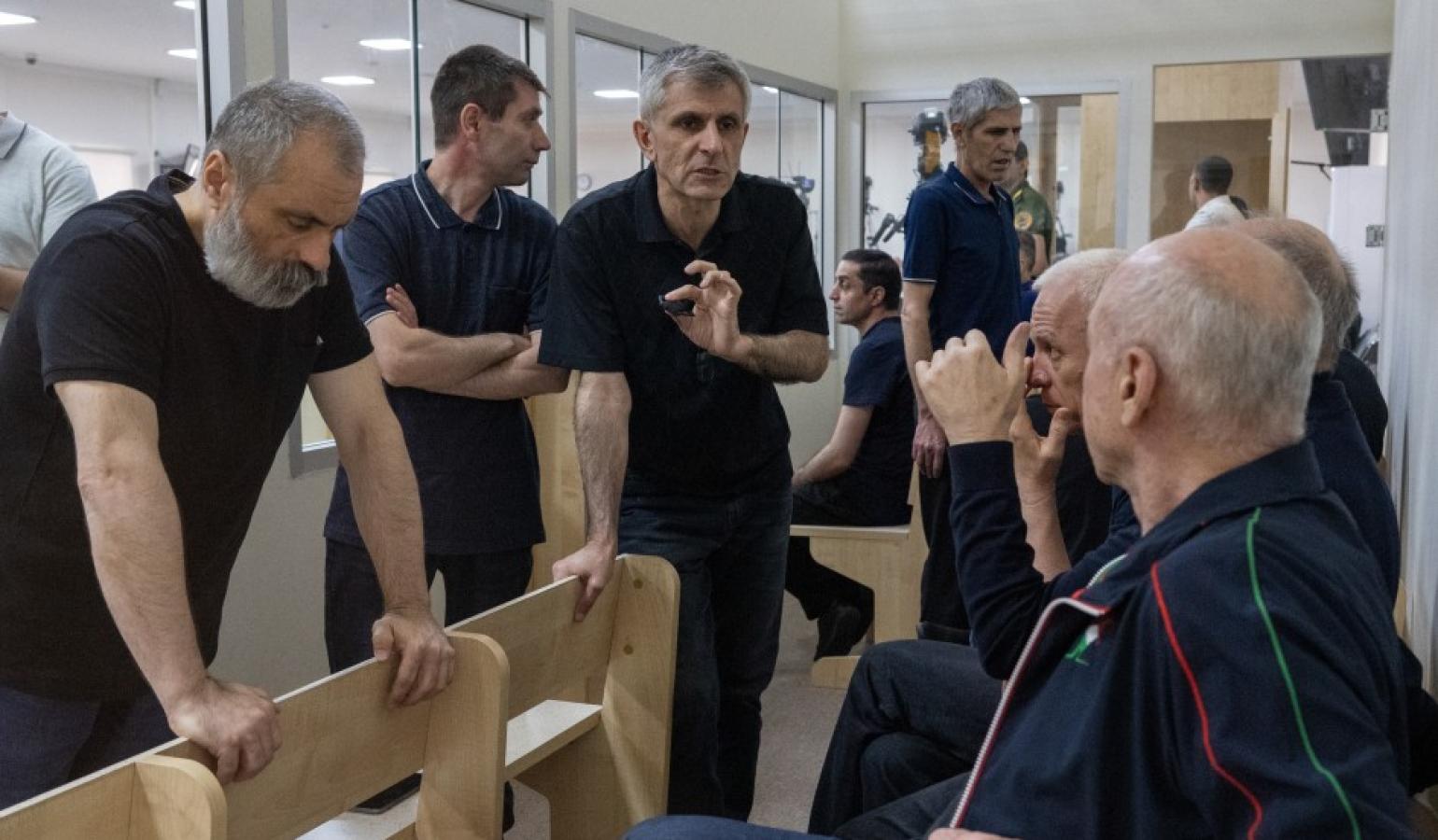
The “trials” of Armenian prisoners held in Baku have concluded. Nevertheless, even more than two months later, the verdicts have not been provided to the defendants, their family members, or their lawyers. The prisoners’ family members have raised this issue, and Ruben Vardanyan spoke about it during a brief phone call. In a conversation with Medialab, Siranush Sahakyan, Director of the “International and Comparative Law Center” and the Armenian office of the “Armenian Legal Center for Justice and Human Rights,” expressed her opinion on the issue. “We also see a pattern here, since the verdicts are key documents, the examination of which makes it possible to effectively challenge the judicial process and the violations of fair trial guarantees that occurred during it. By not providing the verdicts, in essence, either the process is being delayed, or there is an attempt to render appeals in international instances practically ineffective,” said Sahakyan.
The right to an effective domestic remedy, as well as the right to apply to international instances is internationally guaranteed. Sahakyan believes that artificial obstacles are being created with regard to the exercise of the right to apply to international instances. The prisoners’ family members have applied for the activation of the “protecting power” mechanism provided for under humanitarian law. According to Sahakyan, this is a distinct mechanism and is not the same as consular visits. “The right to consular visits belongs to the state whose citizen is deprived of liberty in a foreign country. With this request, families, lawyers, as well as civil society organizations had applied as early as last year, when information had already been received about the termination of the activities of the Red Cross office in Baku. But since to this day we do not have the activation of the mentioned mechanism, and the Red Cross no longer carries out regular activities in Azerbaijan, it has become necessary to bring the ‘protecting power’ mechanism into discussion, the essence of which is that the observance of humanitarian law norms is entrusted to a third, neutral state,” said Sahakyan. Speaking about the place and condition of detention of the prisoners, Sahakyan confirmed that currently there is no actual change in them.
Immediately after the conclusion of the trials, international reactions emerged, in particular from Amnesty International, and numerous concerns have been raised, including the issue of access to the verdicts. Nevertheless, in recent weeks this issue has not been under the special attention of international organizations, and no new reactions or developments have been recorded. The issue of non-provision of judicial acts has also been raised in proceedings related to the European Court. Azerbaijan once again applied to the Court, requesting to lift the interim measures and to terminate the obligation imposed on Azerbaijan to submit reports. However, last Friday the Court rejected the position of the Azerbaijani side and obliged the State to provide information not only on the prisoners’ health condition, but also on the trials: either the full verdicts must be provided, or their summarized versions, in which the court’s reasoning and the “evidence” on which the guilty verdicts were based will be clearly reflected. Sahakyan considers this an important development. “Thanks to the involvement of the European Court, we will be able, albeit with delay, to receive those verdicts,” said the human rights defender.
Speaking about the policy pursued by the Republic of Armenia on the issue of prisoners, Siranush Sahakyan expressed concern regarding the activation of the consular service mechanism, noting that they are closely following what the state’s response will be regarding the process of appointing a protecting power.
“These are clearly humanitarian issues, and moreover, they are connected with the sovereign rights of states guaranteed by international conventions. Any restriction in this regard will lead to interstate disagreements and disputes, which naturally also have legal means of resolution, therefore, these are not political issues and in no way can they endanger Armenian-Azerbaijani relations. Moreover, resolving humanitarian issues through the activation of international mechanisms can bring that peace closer. This is an important indicator for us to reveal the real political will of our state. We are proactive: all initiatives that, with Armenia’s involvement, can mitigate the humanitarian crisis are important, and in this regard we come forward with constructive proposals and hope that the state will be responsive,” said the human rights defender.