
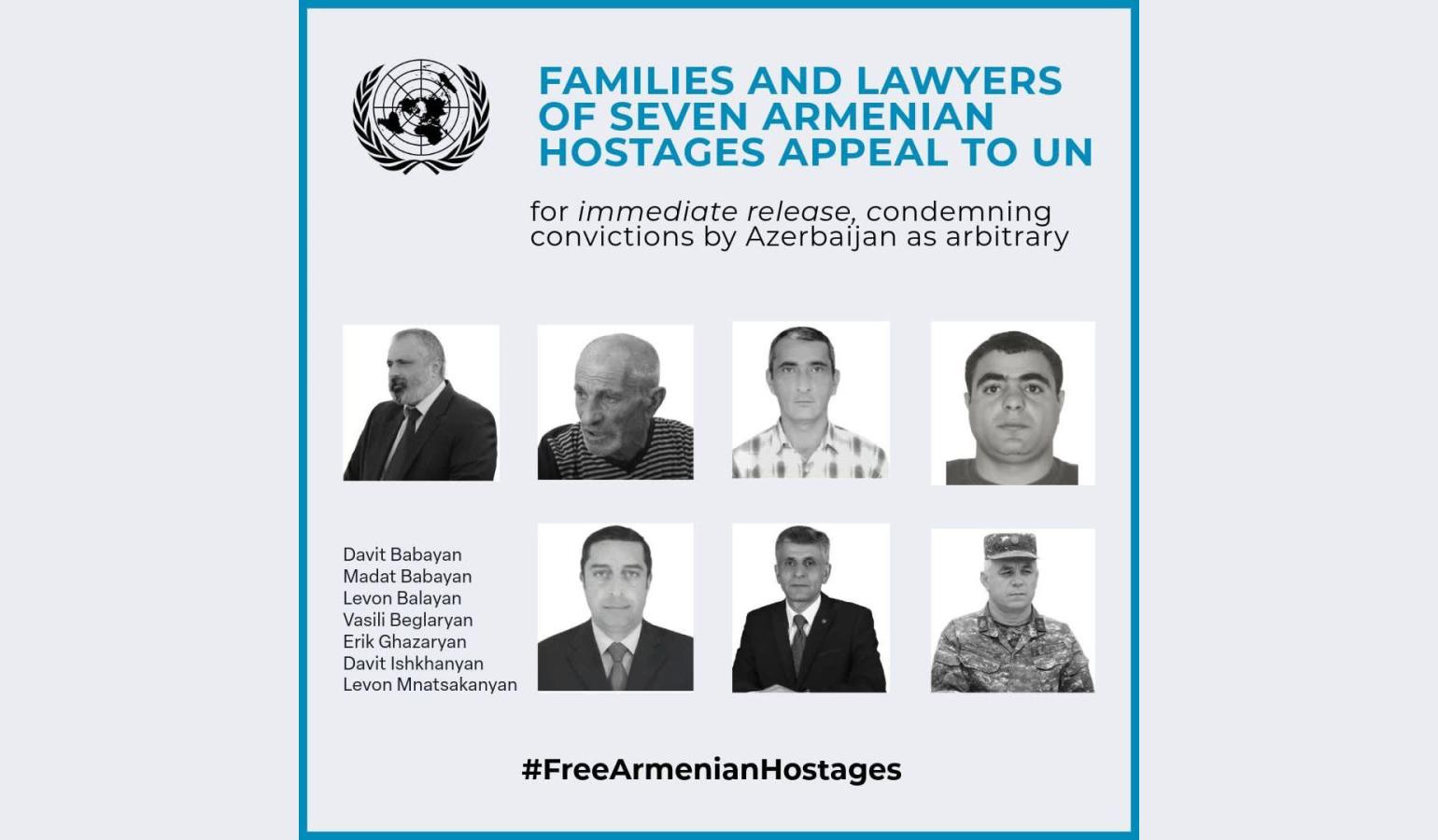
The International and Comparative Law Center, in cooperation with the Armenian Legal Center for Justice and Human Rights, together with international lawyers representing the families of seven Armenian hostages currently imprisoned in Azerbaijan, has filed a formal petition to the United Nations Working Group on Arbitrary Detention (WGAD), calling for urgent action in the cases of seven Armenian detainees currently held in Azerbaijan.
The case concerns Davit Babayan, Madat Babayan, Levon Balayan, Vasili Beglaryan, Erik Ghazaryan, Davit Ishkhanyan, and Levon Mnatsakanyan - Armenian nationals captured by Azerbaijani forces between September 19 and October 3, 2023, in the aftermath of the military offensive in Nagorno-Karabakh. Among them are former political leaders, military figures, and individuals with differing roles during the conflict. On February 5, 2026, Davit Ishkhanyan, former President of the National Assembly of Artsakh; Davit Babayan, former Foreign Minister; and Levon Mnatsakanyan, former Minister of Defense and Commander of the Defense Army, were sentenced to life imprisonment. The remaining four received prison terms ranging from 15 to 19 years. All seven have now spent well over two years in detention.
The petition argues that their detention is arbitrary on multiple grounds recognized under international law. It states that the detainees were captured in the context of an armed conflict that qualifies as an international armed conflict, meaning they should have been treated as prisoners of war under the Geneva Conventions. Instead, Azerbaijani authorities prosecuted them under ordinary criminal law, bringing charges such as terrorism, illegal weapons possession, and other serious offenses. According to the submission, such charges are incompatible with the legal protections afforded to combatants and amount to a misapplication of international humanitarian law.
Beyond the legal classification of the conflict, the petition raises concerns that some of the prosecutions may be linked to political positions held by the detainees. It notes that certain individuals, including former officials, had long been publicly associated with the political leadership of Nagorno-Karabakh, and argues that their detention reflects, at least in part, an attempt to penalize political expression and affiliation.
Significant procedural concerns were underscored, particularly that the detainees were tried collectively with other Armenian defendants before a military court, notwithstanding their distinct roles and individual circumstances. Several reportedly refused to confirm statements attributed to them during the investigation phase, raising questions about how such testimony was obtained. In addition, the petition points to restrictions on access to independent legal counsel and the failure to properly communicate verdicts, effectively limiting the detainees’ ability to appeal their convictions.
The situation has been further complicated by the absence of independent humanitarian oversight. Following the expulsion of the International Committee of the Red Cross from Azerbaijan in September 2025, the detainees have remained without regular external monitoring, increasing concerns about their conditions of detention and access to basic safeguards.
The petition also challenges the use of “mercenary” charges against several of the detainees, arguing that such accusations are legally unsustainable. Under international law, individuals cannot be classified as mercenaries if they are nationals of, or residents within, a party to the conflict. The submission emphasizes that all seven detainees are Armenian nationals who lived in Nagorno-Karabakh, making the application of such charges incompatible with both international standards and Azerbaijan’s own legal framework.
Placed in a broader context, the cases represent a larger group of Armenian detainees held in Azerbaijan following the conflicts of 2020 and 2023. Their situation has been repeatedly raised by international bodies, including the United Nations, the European Court of Human Rights, and the European Parliament, all of which have expressed concern regarding their detention and called for adherence to fundamental legal protections.
The petitioners are asking the UN Working Group on Arbitrary Detention to formally recognize the detention of the seven individuals as arbitrary, to call for their immediate release, and to ensure access to international monitoring mechanisms.