
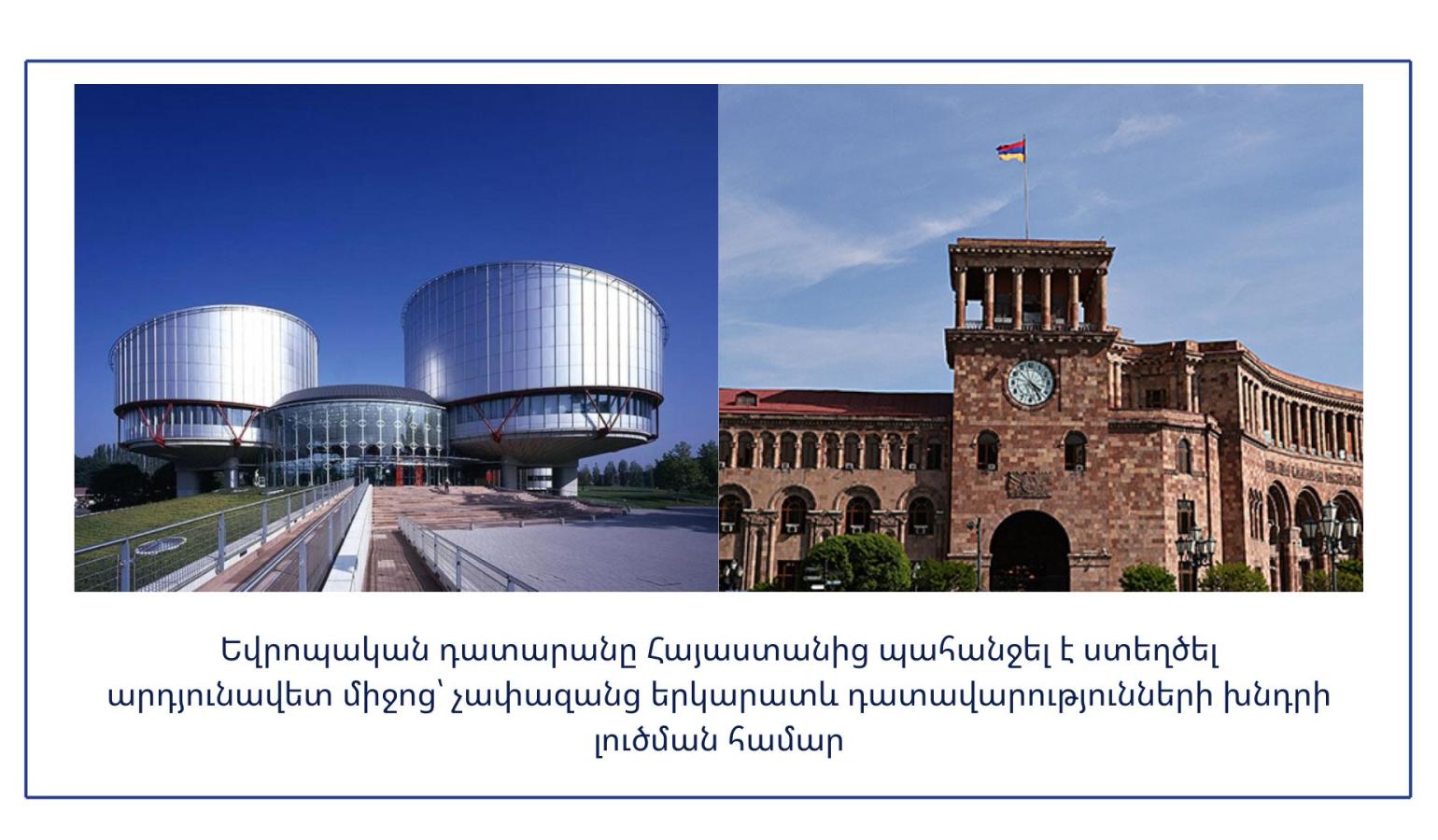
On May 21, 2026, the European Court of Human Rights delivered an important judgment concerning two applications lodged against Armenia (Nos. 34245/23 and 13721/23), finding that the applicants' rights had been violated as a result of excessively lengthy judicial proceedings.
The case concerns not only the protection of the rights of specific individuals, but also systemic problems within Armenia's judicial system, namely unjustified delays in the examination of cases and the absence of effective legal remedies against them.
For years, the applicants had been involved in civil and administrative proceedings without having the possibility of obtaining a final judicial decision within a reasonable time. The Ghazaryans applied to the European Court, arguing that the excessively lengthy examination of their cases in the Armenian courts, lasting approximately eight years, had violated their right to a hearing within a reasonable time guaranteed by Article 6 §1 of the European Convention on Human Rights.
In addition, the applicants stated that Armenian legislation does not provide them with an effective domestic remedy to challenge these violations and obtain adequate compensation.
The applicants are represented before the Court by Siranush Sahakyan, Director of the International and Comparative Law Center, and attorney Karen Meliksetyan. The arguments submitted to the Court emphasized that the problems arising from lengthy proceedings have remained without an effective solution for years, while the measures undertaken by the State have been merely formal in nature.
The Court's attention was drawn to the fact that the problem of lengthy judicial proceedings in Armenia is systemic in nature. Concerns were also raised that, in certain cases, changes introduced within the system had been fragmented in nature, while the application of disciplinary liability had been selective, whereas the fundamental problem of lengthy proceedings had remained unresolved.
The European Court concluded that the duration of the proceedings had clearly exceeded the requirement of a "reasonable time." The Court also found that the compensation mechanism provided for under Armenian legislation does not operate effectively.
This judgment is of particular importance for another significant reason: for the first time in a judgment concerning Armenia, the European Court not only found violations, but also, referring to Article 46 of the Convention, expressly indicated what measures the State should undertake in order to ensure a systemic solution to the problem.
The Court called on the Armenian authorities, as a matter of priority, to establish a special and effective compensation mechanism for the examination of complaints concerning excessively lengthy proceedings, which would comply with the standards developed by the European Court.
The Court also emphasized that such a remedy should be applicable not only to future violations, but also to past violations that have occurred and have not yet been compensated, thereby enabling effective compensation to be granted in respect of both ongoing and already concluded proceedings.
This judgment constitutes an important step not only towards restoring the rights of the specific applicants, but also towards overcoming a systemic problem that has existed within Armenia's judicial system for many years.