
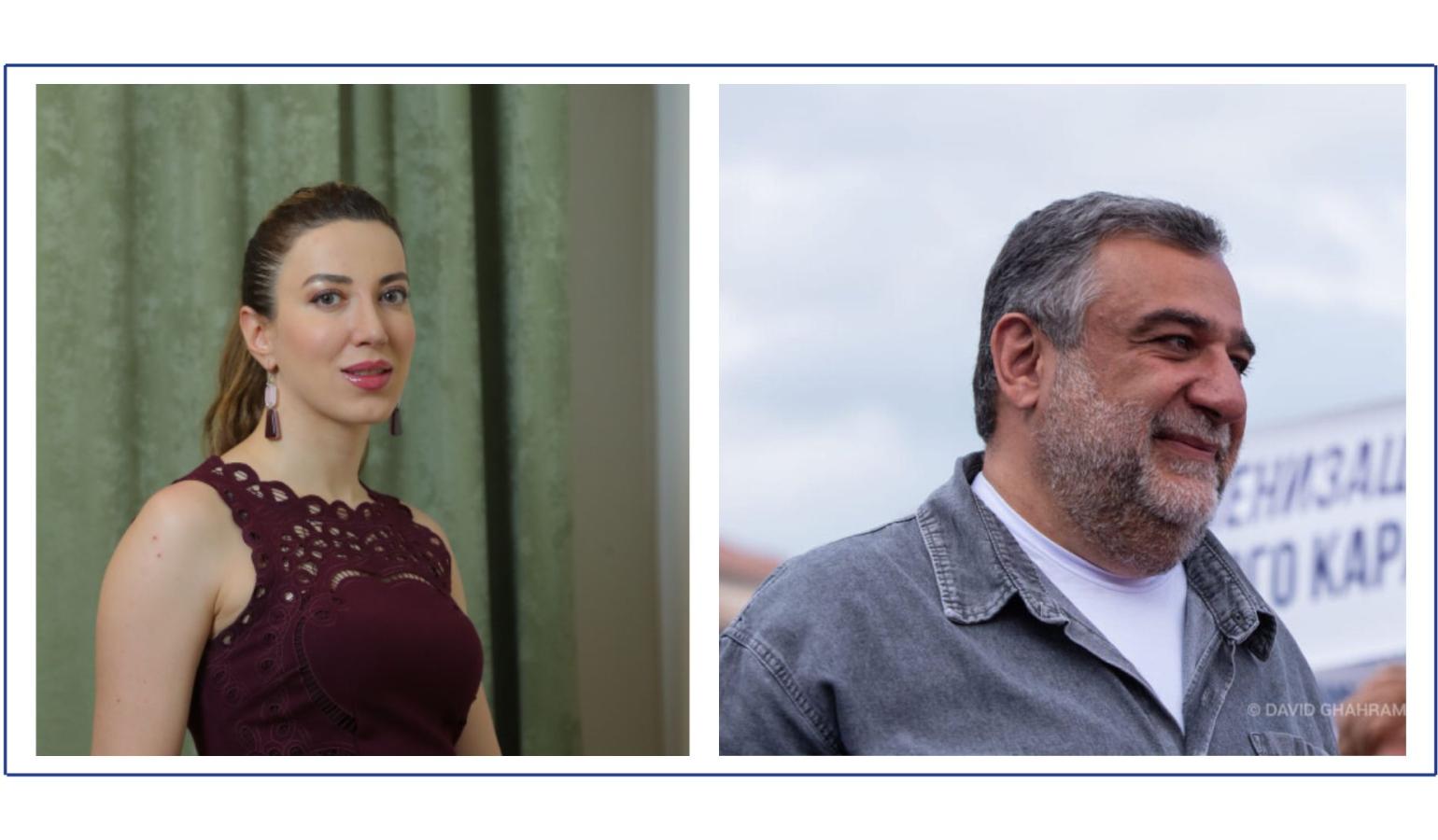
The Director of the International and Comparative Law Center and the representative of the interests of Armenian prisoners before the European Court of Human Rights, Siranush Sahakyan, answered questions from news.am. The interview addressed the application submitted to the European Court of Human Rights in Ruben Vardanyan's case, the trials taking place in the courts of Azerbaijan, and the importance of international legal proceedings.
According to Sahakyan, the official application in Ruben Vardanyan's case was submitted after Vardanyan refused to appeal to a higher instance of the Azerbaijani judicial system, considering that such proceedings could not ensure a fair trial. According to the lawyer, the judgment, which became available to the defense through the family, was translated into English and submitted to the European Court of Human Rights together with the necessary documents. "After becoming acquainted with the judgment, it is evident that during the pre-trial investigation, which lasted for more than one year, and the trial, which lasted for one year, they in fact failed to find even a somewhat logical justification for the 'charges' they themselves fabricated. We are dealing with an unprofessional, disjointed document that cannot withstand any professional criticism, which is called a 'judgment' and on the basis of which our compatriots are, in essence, being unlawfully held hostage in that country," said Sahakyan.
The application describes in detail the violations of eight articles of the Convention for the Protection of Human Rights and Fundamental Freedoms and provides the reasoning confirming them: "First of all, this concerns the right to a fair trial guaranteed by Article 6 of the Convention. Moreover, the violations concern all three paragraphs of this article. The violation of this article alone already calls into question the judicial proceedings as a whole and the legality of the judgments rendered. Violations of certain rights have also been raised in the context of the prohibition of discrimination and the prohibition of restrictions on rights for political purposes."
Siranush Sahakyan also presented a number of particular features of the content of the judgment. According to her, the court concluded that the administration of the unrecognized Republic of Artsakh had operated as a "criminal community" since 1988, and that Ruben Vardanyan, although he had been residing in Moscow in 2020, subsequently, by joining that "community," bears responsibility for all actions attributed to that community. At the same time, the judgment lacks factual data or evidence that would confirm Vardanyan's personal participation in, according to the Azerbaijani allegations, the organization or commission of killings, torture, enforced disappearances, deportations, or other acts against the civilian population.
According to the lawyer, the judgment assessed Ruben Vardanyan's appointment to the position of State Minister as the "violent seizure of power," his charitable and commercial activities as the "financing of terrorism" and "illegal entrepreneurship," and his entry into Nagorno-Karabakh through the Lachin Corridor as the "illegal crossing" of the state border of Azerbaijan.
Addressing the question regarding the effectiveness of international legal mechanisms, Siranush Sahakyan stated: "Of course, it is painful to acknowledge that, under the current circumstances, international law, fundamental human rights, and democratic values are being subordinated to geopolitical interests. But, in my conviction, the legal aspect should not be underestimated, much less should we become discouraged and stop fighting. Personally, as a lawyer, I attach importance to international legal proceedings. I am confident that the steps taken in this direction will sooner or later not remain without consequence, and I am more than convinced that we have every basis to achieve a positive outcome before the European Court of Human Rights."