
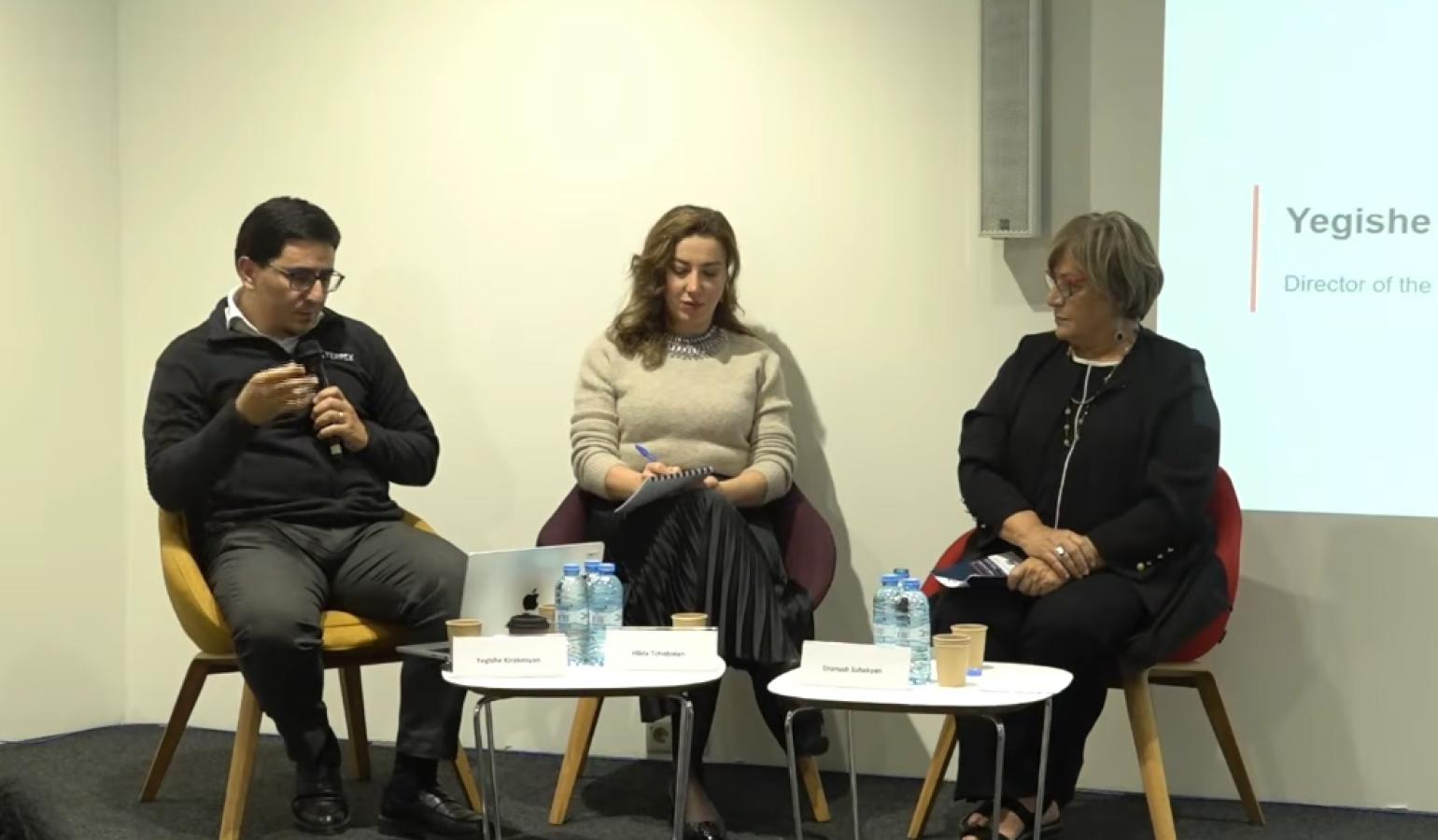
On October 16, the LIBERTAS international conference, titled “Freedom, Justice and Reintegration,” took place in Yerevan, addressing the situation of Armenian captives held in Azerbaijan, possible paths to their release, the social problems faced by those released, and the long-term psychological and social consequences of captivity for society.
The conference brought together international and local experts, lawyers, psychologists, representatives of humanitarian and human rights organisations, diplomats, and civil society representatives. Siranush Sahakyan, director of the International and Comparative Law Center, also spoke at the conference.
In her remarks, she addressed the sham “trials” in Baku. She noted that Azerbaijan’s Constitution formally incorporates international law and that established standards are also enshrined in Azerbaijan’s domestic legislation: “When we speak of violations, these concern breaches of both international law and their own laws equally.”
According to Yeghishe Kirakosyan, head of Yerevan State University’s master’s programme in International Courts and Arbitration, it is incorrect to call the proceedings taking place in Baku trials, as they are directly controlled and directed, with a clear purpose and script: “It is evident that the Baku trials will continue, and a one-sided truth will be imposed. Imposing that one-sided truth will not lead to positive consequences in the long term.”
When assessing evidence of torture against captives, the testimonies of repatriated individuals, medical documents, and reports by international bodies are examined together, providing grounds to conclude that torture in Azerbaijan is a widespread and routine practice, said Siranush Sahakyan.
Armenian captives in Azerbaijan are held incommunicado (completely isolated from the outside world): their only contact with the outside world is through telephone calls, with no direct, in-person contact. Sahakyan reported that the latest information in documentary form had been received from the European Court of Human Rights (ECtHR). The Republic of Azerbaijan itself collects and transmits that information. “Interestingly, we have been provided, for example, with photographs of prison cells where Armenian captives are supposedly held. However, these photographs do not allow us to identify which cells they are or establish any objective connection between those cells and the individuals held in them. In other words, they not only block access for external observers and independent specialists but also restrict any information that could reveal our compatriots’ outward physical condition,” said Sahakyan.
Addressing consular visits, Sahakyan stressed the importance of clarifying the reasons behind the situation between Armenia and Switzerland: “Are we to accept the painful reality that no country on this planet has both a humanitarian commitment and a relationship with the Republic of Armenia within which it would undertake this important humanitarian mission of visiting Armenian citizens on Armenia’s behalf? Armenia has not made such a request and, at least in the case of Switzerland, has not obtained such consent,” stated Siranush Sahakyan.
In addition, Azerbaijan restricts captives’ ability to grant powers of attorney to lawyers and engage in correspondence, isolating them from the outside world. An initiative by Ruben Vardanyan’s wife, Veronika Zonabend, provided an opportunity for people wishing to write letters to the captives to do so. “The letters were collected and sent to the Armenian Government to be delivered through government channels to our captives held in Azerbaijan. However, the Government indicated that they should not be sent to the Government but should instead be addressed directly to Azerbaijan through HayPost. I should note that we have made such attempts for years and continue to do so, but HayPost refuses to send any letter involving communication from Armenia to Azerbaijan. HayPost also issued an official clarification on this matter,” stated Siranush Sahakyan.
Addressing the problems faced by repatriated captives, Khachatur Gasparyan, director of the Intra Mental Health Center, noted that these are primarily economic and health-related: “There are secondary health difficulties, as well as psychosocial and psychological problems. One of the main challenges they face is adjustment. In our society, returning captives are often met with two extreme attitudes: one is excessive sympathy, particularly from relatives and loved ones; the other is avoidance, as discriminatory attitudes develop towards them, based on the notion that if they were taken captive, they must be potential traitors, and so on.”
“Institutional support for people who have returned from captivity is in an extremely poor state,” said Armen Khachikyan, executive director of the ARAR Foundation for Civilizational Research. “Many of them emphasize financial difficulties. According to the study, financial and employment support were the needs most frequently cited by people who had returned from captivity.”