
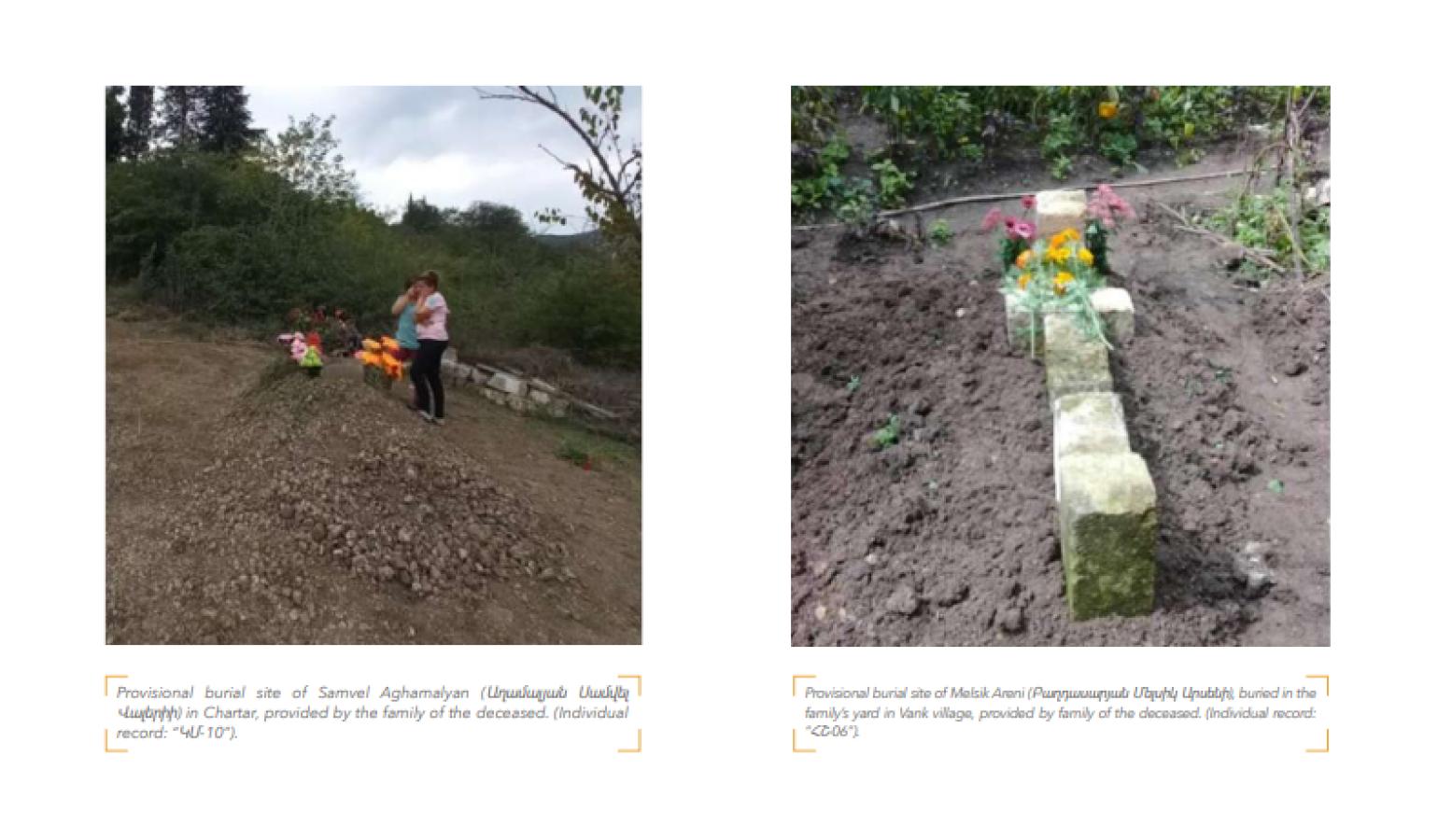
After the war unleashed against Artsakh on September 19, 2023, many families were unable to lay their loved ones to rest with dignity. For example, the family of Valeri Andreasyan was forced to leave his body outside for several days, there was no coffin and no items necessary for a funeral ceremony. They had to make a coffin out of wood and tape and bury Valeri in the brotherly cemetery of Stepanakert.
Valeri's case is not unique. During that period, hundreds of Artsakh Armenians were deprived of their fundamental rights, including the right to mourn the death of a relative with dignity. The International and Comparative Law Center and the Armenian Center for Justice and Human Rights jointly prepared a report documenting 46 cases of temporary burials in Nagorno-Karabakh. Following the one-day military operation, dozens of families were forced to make urgent decisions, often burying their sons, fathers, brothers, and children within only a few hours.
Prior to that, the Armenian population of Artsakh had lived for more than nine months under conditions of complete blockade. Azerbaijan had closed the Lachin Corridor, depriving Artsakh of any connection with the outside world. The attack of September 19 became the final stage of the blockade, and as a result of the war, the entire population of Artsakh was subjected to forced displacement.
Amid the chaotic conditions of the evacuation, relatives of those killed were often forced to organize temporary burials on their own. Some buried their loved ones in mass graves, others in common sections of village cemeteries, and even in the yards of their own homes, covering the bodies with soil.
During the preparation of the report, documentary evidence concerning 46 temporary burials was collected directly from the families of the deceased. These included servicemen killed during combat operations, people killed as a result of drone and artillery strikes, as well as civilians. Among the victims was also a nine-year-old boy who was killed as a result of Azerbaijan's aerial attacks against the civilian population.
Families were deprived not only of the possibility of arranging proper burials, but also of the right to observe religious and cultural rites. According to Armenian tradition, family members visit the graves of their relatives on the seventh and fortieth days after the burial, as well as every year thereafter. However, following the forced displacement, thousands of Artsakh Armenians are no longer able to visit the graves of their relatives.
Moreover, temporary burial sites are not considered permanent cemeteries. Today, they are under the immediate threat of destruction or desecration. Azerbaijan's practice of desecrating Armenian cemeteries and cultural heritage deepens families' fears that the remains of their loved ones may be destroyed.