
“It was shelled, and a Smerch (Russian for "tornado") also hit; I personally saw it. I saw smoke rising, I came and saw that people were in their basements.”
“Even now (he means after being relocated to Armenia – ed.), when you ask that small child, ‘Are you going to kindergarten?’ He says, ‘No, I’m going to the village kindergarten.’ You feel oppressed, that you are not in your birthplace, on your own land.”
“To this day, children are scared when they remember the day of the attack.”
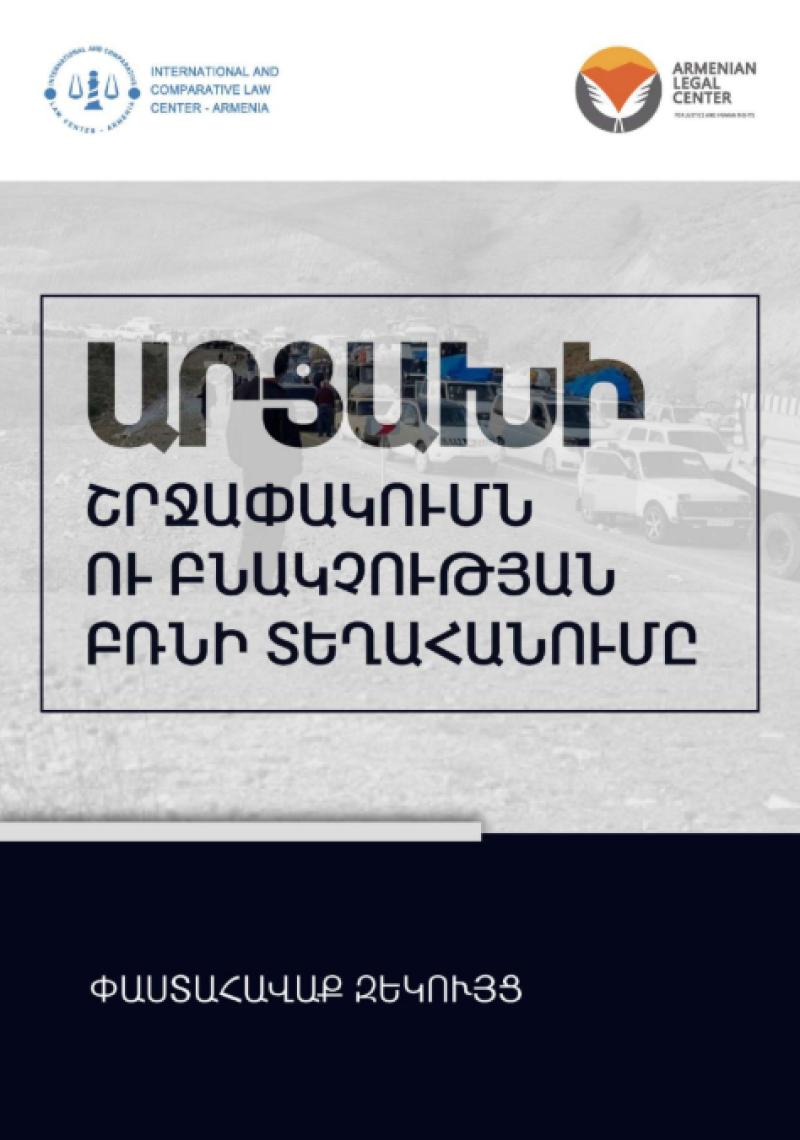
The “Center for International and Comparative Law,” in cooperation with the “Armenian Legal Center for Justice and Human Rights,” has prepared a fact-finding report that documents the processes of the blockade of Artsakh and the forced displacement of the Armenian population, revealing through human stories the mass violations of human rights and manifestations of a deep security crisis. The realities recorded in the report are given a legal assessment within the frameworks of human rights and international humanitarian law. The report documents the processes of the blockade of Artsakh and the forced displacement of the population, as well as the mass human rights violations resulting from them. For this purpose, extensive factual material has been collected, systematized, and analyzed, reflecting people’s everyday living conditions and experiences during the stages of the blockade, the September 19 attack, and displacement.
Data collection was carried out through qualitative research, in particular through individual interviews conducted with persons forcibly displaced from Artsakh. Interviewees were given the opportunity to share their personal, family, and community experiences. The report is based on 83 interviews. The average age of the interviewees is 48; 41% are men and 59% are women. They represent 5 cities of Artsakh, including the capital, and 37 rural settlements. Along with the interviews, photographs, copies of documents, videos, and other evidence were also collected. All interviews were conducted with the consent of the interviewees and documented with detailed transcripts.
“I left 5 tons of wheat, 10 tons of barley.”
“I had a very large and valuable library, more than 1,000 books. It was the accumulation of my entire life, and for me it is the greatest loss.”
“I put our photos into the chest, the children’s discs, postcards that the children made at school and kindergarten, the first tooth, the maternity hospital papers for the child, my apron from my last school bell.”
The report describes the population’s everyday living conditions during the blockade: difficulties in access to food, energy, water, communications, medical care, and education; food shortages and hunger; bread and food lines; price increases; problems with electricity, water, and heating; restrictions on transportation, internet, and telephone communications; as well as challenges related to children; the security environment formed under blockade conditions, characterized by constant threats, psychological pressure, and uncertainty. The report also includes analyses of border tensions, shootings and manifestations of violence, threatening statements made at the state level, and threats circulating online. Separate attention is given to the role of Russian peacekeepers in Artsakh, regarding which the population’s assessments were contradictory. The conditions of sheltering and evacuation of the civilian population are covered, the damage caused to life, health, and property as a result of the attack, as well as cases of missing persons and captivity. The report also presents details about the process of forced displacement of the population, property losses, and the subsequent lives of the displaced in Armenia.
The actions carried out against the Armenian population of Artsakh were systematic in nature and aimed at eliminating the existence of Armenians in the region. This fact-finding report is not only a record of the past but also a foundation for future accountability and the establishment of justice. It can serve as a documented basis for international and national bodies, courts, human rights organizations, as well as academic and political analytical circles, contributing to the protection of the rights of the displaced.
The report is intended to serve as a documented basis for legal proceedings. It will be sent to international partners and international organizations. The stories recorded in the report, as documented evidence, have been submitted to the International Criminal Court as proof of violations committed against the Armenian population of Artsakh. The study may be useful for developing public policies for the social and legal protection of the displaced, psychological rehabilitation, and the protection of property rights. And finally, this report is a means of preserving individual and collective memory.