
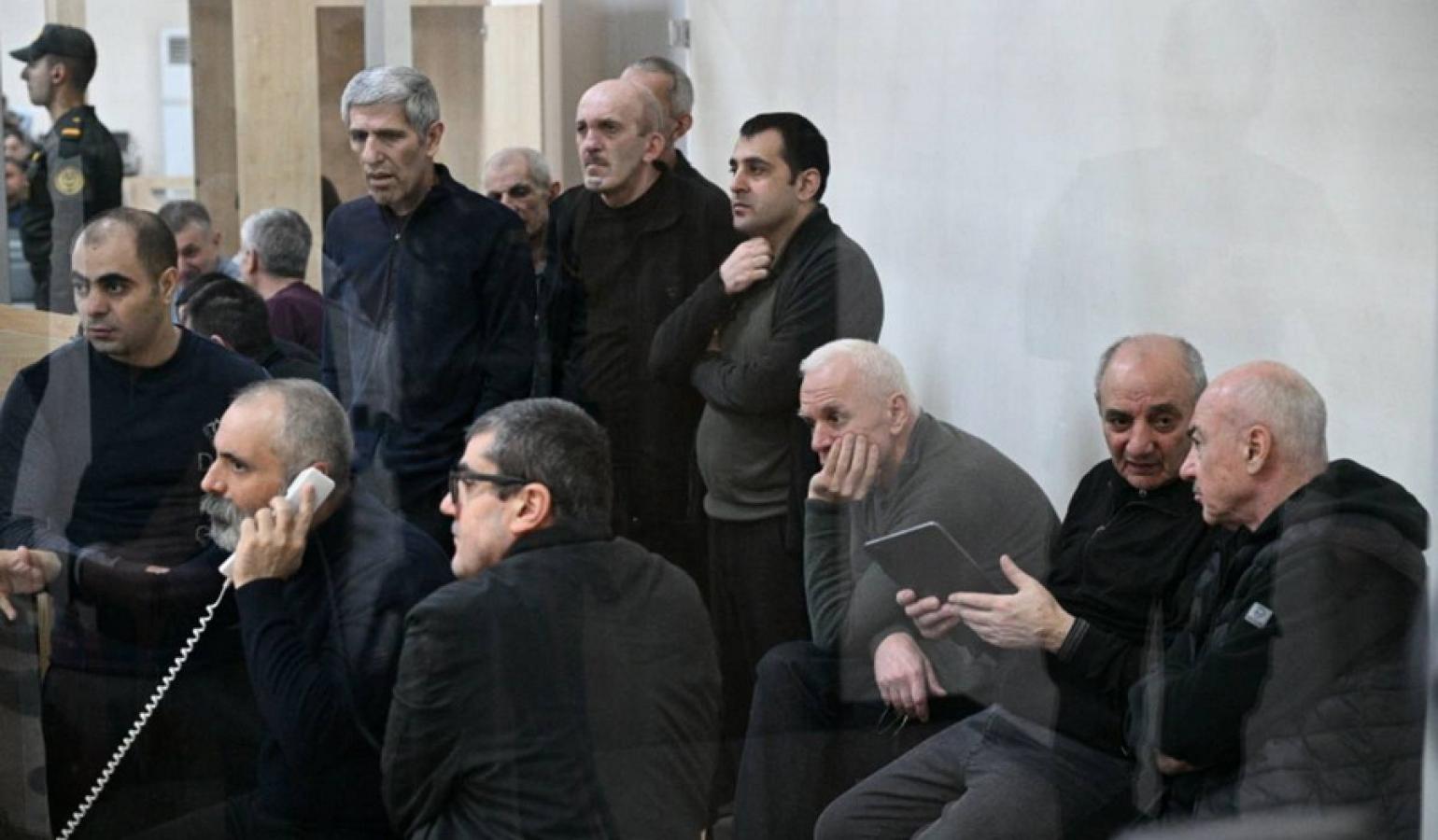
Siranush Sahakyan, Director of the “International and Comparative Law Center” and the Armenian office of the “Armenian Center for Justice and Human Rights,” addressed the violations of the rights of Armenian prisoners held in Baku, Davit Babayan’s message from the Baku prison, international legal mechanisms, and the obligations of the Republic of Armenia during LaMedia’s “Direct Speech” program.
Referring to the message sent from the Baku prison by former Artsakh Foreign Minister Davit Babayan, through which Babayan also reported the disappearance of his letters, the human rights defender stated that this case is further proof that the trials conducted in Azerbaijan are political in nature and do not comply with fair trial standards. According to her, even handwritten notes made by Armenian prisoners during the trials were confiscated, while appellate proceedings were merely formal in nature. “These trials have been carried out entirely under the direction of Azerbaijani state policy, and the only mechanism for delegitimizing them is international judicial bodies,” said Sahakyan, informing that applications are already being prepared for the European Court of Human Rights regarding the cases of former military-political leaders of Artsakh. In addition, on April 24, applications were also submitted to the UN Working Group on Arbitrary Detention on behalf of Armenians held in Baku.
Recently, Ruben Vardanyan sent a message from the Baku prison in which he essentially raised two issues: first, a visit by the Human Rights Defender of the Republic of Armenia to Baku, and second, visits by families. Speaking about possible visits, Sahakyan noted that such visits could have important psychological significance, but they should not become a tool of Azerbaijani propaganda. According to her, Azerbaijan has repeatedly used Armenian prisoners for propaganda purposes in the past by organizing staged interviews and public statements. “In the case of such visits, we must exercise caution so that our compatriots do not become instruments of the Azerbaijani propaganda machine. I believe the visit should take place within the framework of clear agreements and should not be aimed at diverting attention from the issue of release, because the main issue is clear: Armenians are being held in unlawful detention. Even if, during unlawful detention, they are nevertheless given the opportunity to meet with their families, this by no means signifies that the violation of rights has ceased. There is only one remedy for that - their immediate release,” said Sahakyan.
The human rights defender noted that the Armenians held in Baku are, in fact, in an “incommunicado” situation, meaning they are deprived of contact with the outside world. The institution of the Azerbaijani Human Rights Defender, presented by the Azerbaijani authorities as an alternative, is not considered an independent body under international standards and has repeatedly acted as a cover-up mechanism for human rights violations. “And under such conditions, they are trying to convince the world that the Azerbaijani Ombudsman is an independent mechanism, that nothing has happened because Red Cross visits have been replaced by visits from the Azerbaijani Ombudsman. I should note that, first of all, such visits have not taken place in all cases, and moreover, we are aware of information that during these visits, the Ombudsman or Ombudsman staff also demonstrated degrading behavior. For example, during visits by the same Ombudsman staff, Armenian prisoners were forced to shout, ‘glory to Azerbaijan,’ ‘glory to Aliyev,’ and so on. In other words, even these visits have been accompanied by human rights violations,” said the human rights defender.
Sahakyan also noted that the process of returning prisoners has long lost its exclusively humanitarian nature and has become politicized. In her assessment, almost all repatriations that have taken place so far have been conditioned by political concessions or reciprocal political agreements. As examples, she mentioned the transfer of minefield maps to Azerbaijan, the release of Azerbaijani convicts, as well as the return of Armenian prisoners carried out simultaneously with the release of Syrian mercenaries. Referring to the actions of the Republic of Armenia, Siranush Sahakyan stated that although some important international judicial processes have been carried out, there are also serious shortcomings. In particular, she considered the provisions of the peace agreement that envisage mutual withdrawal of international legal claims to be alarming.
“This means abandoning legal claims, as well as promoting a thesis that speaks of a peace devoid of humanitarian principles. In general, justice is the precondition for peace, and the international community, as a rule, does not support countries that are ready for peace but reject justice, because the only precondition for long-term peace is justice,” Sahakyan emphasized, adding that the Republic of Armenia has still not exercised its right of consular visits regarding Armenian citizens held in Azerbaijan. “We submitted that request a year ago, yet within the course of a year the Ministry of Foreign Affairs has still not clarified why those visits are not taking place. Does the Republic of Armenia not wish to visit its citizens and has decided to neglect them, or is the Republic of Armenia nevertheless persistent, but certain obstacles are being created by the Azerbaijani authorities? We see no answer and no transparency. Yet common sense suggests that if we are moving toward peace, society should possess any information related to Armenian-Azerbaijani relations,” said Sahakyan.