
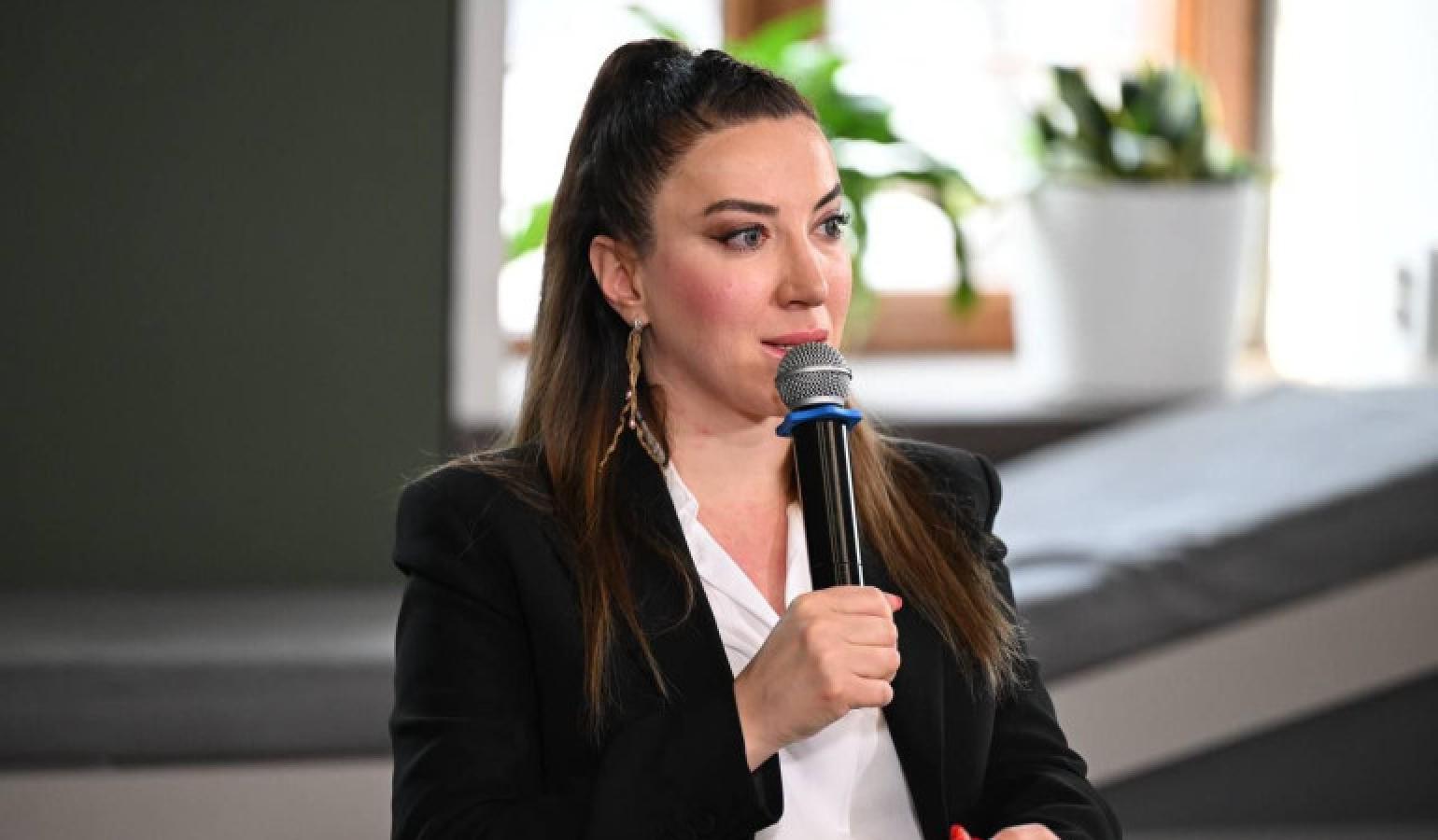
On January 17, the director of the “Center for International and Comparative Law,” Siranush Sahakyan, held a press conference dedicated to the anniversary of the “trials” of Armenian prisoners illegally detained in Baku. On January 17, 2025, sham “trials” of Armenian prisoners, including the military and political leaders of Artsakh, were launched at the Baku Military Court, during which no evidence or factual data was ever presented to confirm the reality of the “crimes” cited in the charges. “During the one year of ongoing ‘trials,’ when more than 150 court hearings were held, we still did not see concrete facts or evidence, and the alleged acts remained unproven,” said the human rights defender.
During the press conference, Sahakyan presented in detail the entire course of the trials, spoke about the conditions of detention of the prisoners, the discrimination shown, religion-based treatment, the artificial prolongation of the processes and their possible reasons, as well as about the recently returned Armenian prisoners and Syrian mercenaries.
Sahakyan emphasized that these trials taking place in Baku should not be viewed solely in the context of legal processes, as they primarily have political significance. According to the lawyer, civil society institutions play an irreplaceable role by informing international partners about the situation, the problems, and the urgency of resolving the issue, but the return of prisoners also has a political component.
“Behind every return there are negotiations and agreements, therefore, in my assessment, return is possible exclusively with the involvement of representatives of public authority. Without their involvement, without a negotiation process, we will take the issue to a dead end. In this regard, the best model is coordinated work: public authorities must be demanding so that this issue is resolved as soon as possible through negotiations, while civil society institutions must create the right environment and, by drawing the attention of international partners to the problem, exert additional pressure on the Azerbaijani authorities so that this issue is resolved,” said Sahakyan.
During the press conference, humanitarian issues related to the prisoners held in Baku were addressed, in particular their continuously violated rights, as well as the role of international organizations. Sahakyan noted that the latest return of prisoners has created a certain hope, but the continuity of the process and the full release of all prisoners must become the subject of joint efforts by international legal mechanisms, the political environment, and civil society.
“For us, the return of every Armenian is welcome, and there can be no second opinion on this issue. After the return of 32 Armenian prisoners in December 2023, an ‘ice effect’ was created, when for a long time no new person was returned. Although in 2025 we had a preliminarily signed agreement with Azerbaijan around peace and, against that backdrop, expected more good-neighborly relations, nevertheless, Armenian prisoners were not repatriated. In this regard, the return of 4 people that took place days ago inspires hope that this process may be continuous,” said Sahakyan.
Referring to the conditions of detention of the prisoners, the human rights defender noted that the footage being circulated shows rooms designated purely for video recording, the purpose of which is to show the domestic audience that humanitarian norms are allegedly being observed in Azerbaijan.
As for the trials, they have concluded, and the judges must make decisions. Sahakyan noted that the decisions will become known by the end of this month. In the case of Ruben Vardanyan, there are certain tendencies toward delaying the process. “This fact is visible to us, but it is still difficult to say the reasons. In addition, isolation from the outside world has also increased. In particular, the family reports that the frequency of calls has decreased,” said Siranush Sahakyan.