
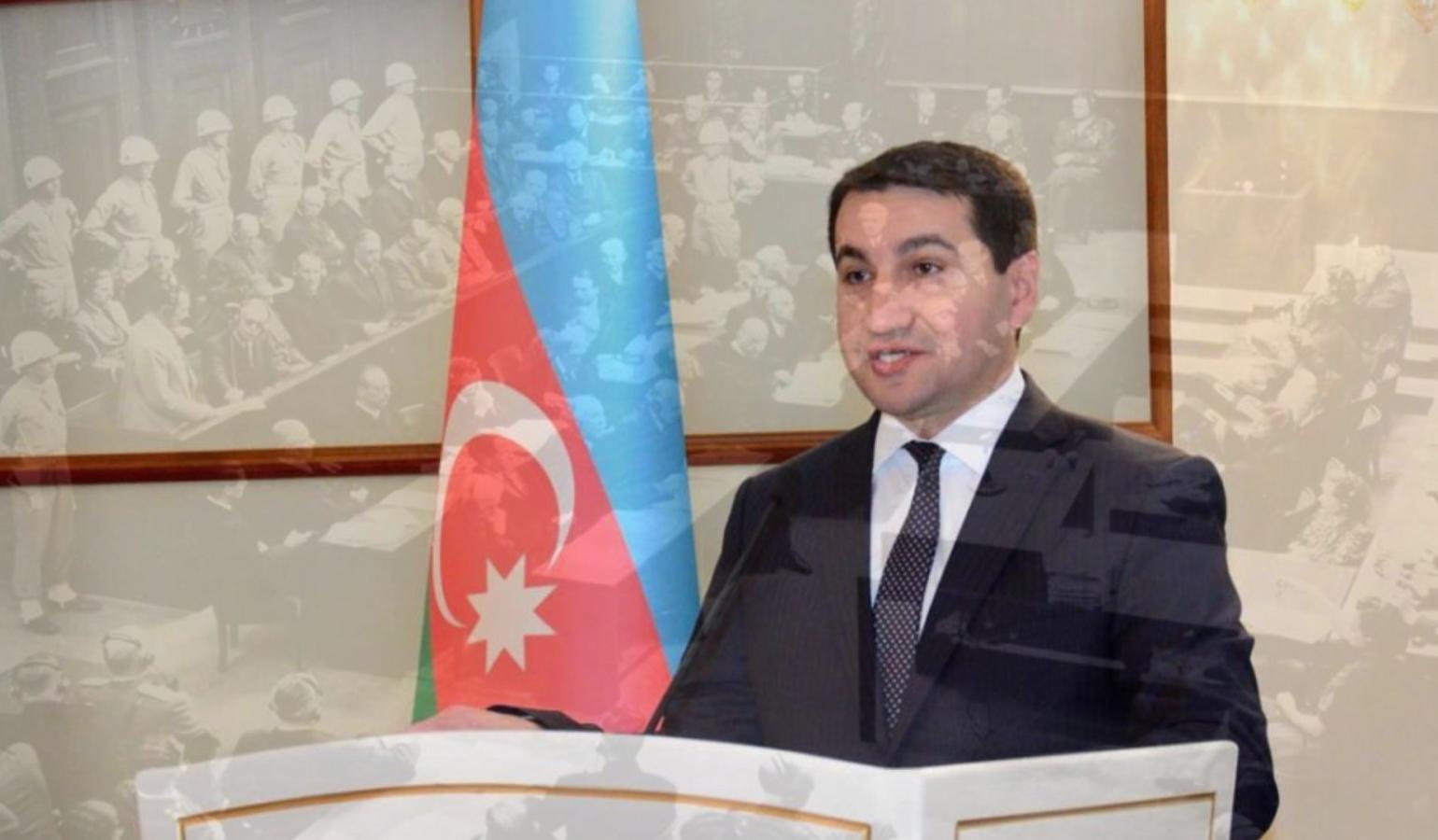
The sham trials of Armenian prisoners have concluded in Baku. Almost all the verdicts were predictable. Nearly all the military-political leaders of Artsakh were sentenced to life imprisonment. A few days ago, the verdict against the former State Minister of Artsakh, Ruben Vardanyan, was also published: he was sentenced to 20 years of imprisonment. The Assistant to the President of Azerbaijan, Hikmet Hajiyev, compared these “trials” to the Nuremberg Tribunal. “The decision of the Baku court regarding oligarch Ruben Vardanyan was not only the administration of justice, but also the symbolic and logical conclusion of the 30-year conflict that caused immeasurable suffering to the people of Azerbaijan,” Hajiyev wrote on his X account.
According to Siranush Sahakyan, Director of the “International and Comparative Law Center,” the statements of the Assistant to the President of Azerbaijan prove that the “trials” were not intended to address issues of individual responsibility by attributing specific acts to each person, but rather to take revenge for the right to self-determination of Artsakh, the entire burden of which is being attempted to be placed on the former military-political leaders. “It was symbolic that they spoke about the ‘Khojaly genocide,’ and the day of the announcement of the verdicts was also conditioned by the February events. And this in a situation where the ‘Khojaly genocide,’ as such, did not exist; it has been denied by the international community. Let me also note that the academic and historical disputes surrounding the so-called ‘Khojaly genocide’ are fully protected within the framework of the right to freedom of expression, and the case examined by the European Court of Human Rights, ‘Fatullayev v. Azerbaijan,’ was precisely about the fact that even Azerbaijanis have the right to question the official version,” said Sahakyan in an interview with News.am.
Hajiyev also wrote: “Our expectation was that, following the example of the Nuremberg trials, the International Criminal Tribunal for the former Yugoslavia, or the International Criminal Tribunal for Rwanda, a similar judicial body would be established in the case of Azerbaijan as well.” According to Siranush Sahakyan, such a statement also indicates a lack of literacy: “Of course, perhaps the statement was political, however here we also see an official who is not sufficiently prepared. Let me note that those tribunals were formed under conditions when an institutionalized international judicial system in the field of criminal justice had not yet been established, and those tribunals were introduced to respond to each specific situation; however, later, with the adoption of the Rome Statute, the system was institutionalized, and the International Criminal Court began to operate, which is already competent to address crimes of an international nature by raising the issue of individual criminal responsibility of perpetrators, and there was no need to establish such a tribunal,” said Sahakyan.
In response to the journalist’s question as to whether it is possible to use Hajiyev’s statement as evidence in the European Court of Human Rights to prove that what took place in the Baku courts had a political nature, Sahakyan answered affirmatively and added that there is other evidence as well. “We substantiate the facts on the basis of evidence existing in objective reality (and not only), and not so much on the statements of Azerbaijani officials. However, statements of this nature can, of course, assist us in that process. It is clear that they are subject to monitoring, those statements are subsequently combined with objective data and more substantively demonstrate the veracity of the theses of the Armenian side. And our assertion is that in the Azerbaijani courts the right to self-determination of Artsakh was convicted; it has not been rejected, it is recognized in international law, and the self-proclamation of Artsakh’s independence has never violated international law, and here there have merely been political processes of recognition. Therefore, yes, we also attach importance to such statements by officials,” said Siranush Sahakyan.
If previously in Azerbaijan the rights of ethnic Armenians were violated by law enforcement bodies and representatives of the armed forces, then at this stage the administrative practice of violating rights on the basis of ethnic affiliation is being recorded by the courts. These issues may be raised before the European Court of Human Rights. “The ECHR is well aware of Azerbaijani realities, and there are already dozens of cases there in which it has been recorded that the judiciary has been used as a tool against dissenters for political purposes. Hajiyev’s statement clearly showed that the trials concerned the highly politicized and highly sensitive issue of the Nagorno-Karabakh conflict, which means that courts that are dependent could not be impartial in such sensitive matters. These issues, of course, will be raised together with the remaining violations of human rights,” said Sahakyan, also informing that the families of the prisoners largely understand the importance of the legal process, express their support for those processes, and on the basis of individual complaints it is possible to fully demonstrate the unlawful nature of the Baku trials.
Speaking about the available reliable information regarding the health condition of the Armenian prisoners and the conditions of their detention, Sahakyan said that they receive information through the European Court of Human Rights. “The Government of Azerbaijan has a legal obligation to periodically submit a report to the Court, which, although reluctantly and with violations of procedural deadlines, it nevertheless fulfills. Those documents, as a rule, also contain information regarding health conditions. Sometimes they include examination results, however they, as well as the rest of the information, are not complete,” said Sahakyan.