
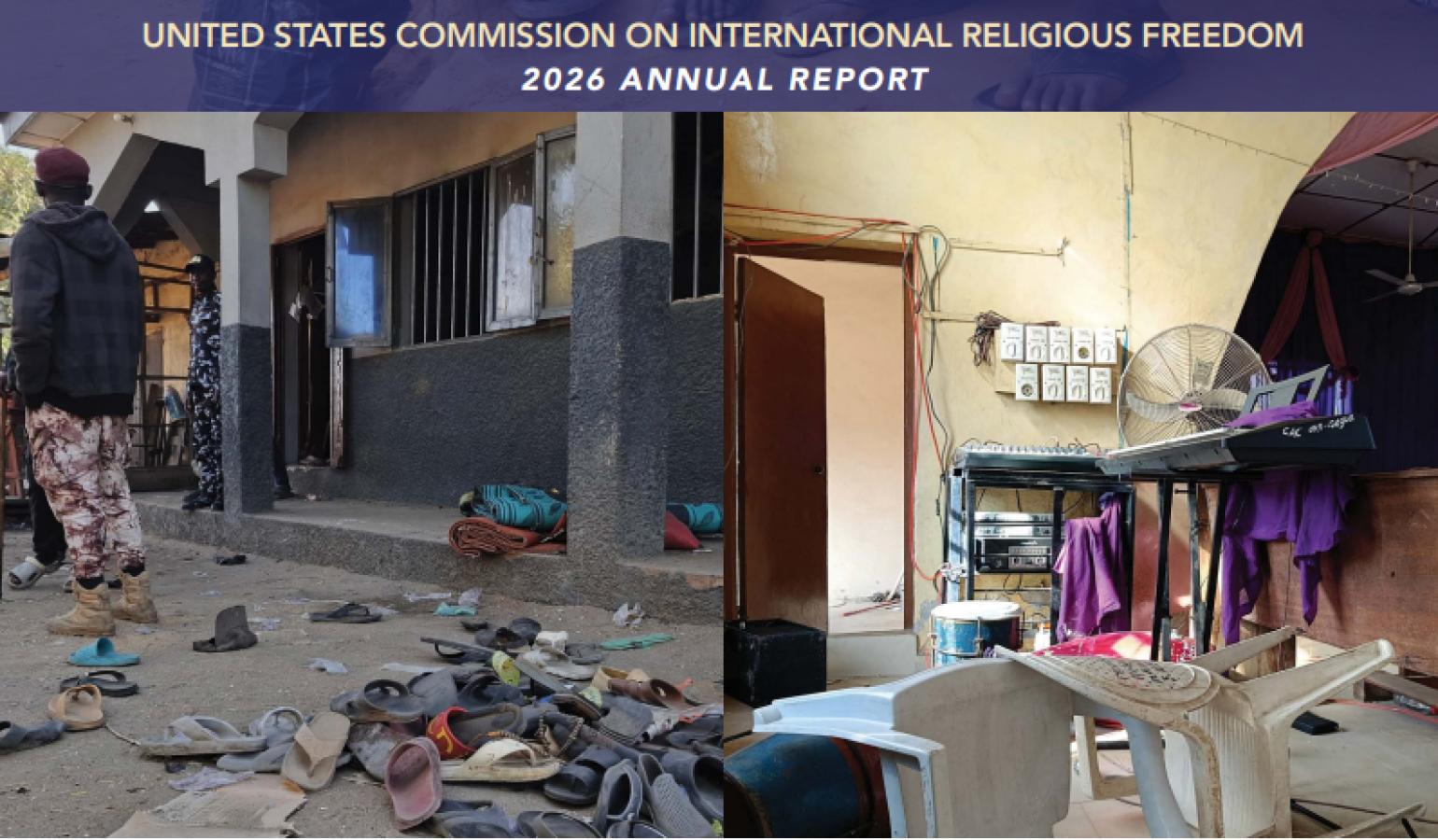
The United States Commission on International Religious Freedom (USCIRF) has published its 2026 annual report, which assesses the state of religious freedom in various countries around the world and presents recommendations for U.S. foreign policy. The report is primarily intended for the United States Congress and the United States Department of State and covers issues related to religious freedom in numerous countries.
In the report, USCIRF mentions Prime Minister Nikol Pashinyan’s campaign against the Church in the section titled “Attacks on and Repression of Religious Leaders.” “In Armenia, Prime Minister Nikol Pashinyan’s statements about the Armenian Apostolic Church (AAC) raised concerns about potential government interference in the AAC’s religious autonomy. Throughout 2025, Prime Minister Pashinyan proposed establishing and personally appointing a council to elect a new AAC leader, and elevated clergy who aligned with his agenda to oust the current catholicos. Pashinyan’s attacks on Catholicos Karekin II coincided with the arrest of AAC clerics and other lay members who had criticized or expressed political opposition to Pashinyan’s government.” states the report.
The report also separately addresses events that took place in Azerbaijan in 2025 and prior, the treatment of religious minorities, foreigners, and Shia Muslims, as well as the condition of religious and cultural heritage in the territory of Nagorno-Karabakh. According to USCIRF, following the 2020 44-day war, the 2023 forced displacement, and the establishment of control over Nagorno-Karabakh, concerns regarding the preservation of Armenian religious heritage have sharply increased. The report notes that satellite monitoring and information obtained from various sources document cases of damage and destruction of Armenian religious monuments in Nagorno-Karabakh: “Historic Armenian religious sites in Nagorno-Karabakh and the surrounding territories remain at risk following Azerbaijan’s retaking of the territories in 2020 and 2023. As of July, satellite imagery identified eight destroyed and another 10 damaged religious sites, including churches, cemeteries, and other artifacts,” states the report.
In addition to the issue of cultural heritage, the report also addresses the religious rights of Armenian prisoners of war and detainees. “The nearly two dozen Armenian Christian prisoners from Nagorno-Karabakh, who were tried behind closed doors without adequate legal counsel, have received beatings, psychological abuse, lack of access to medical care and proper food, denials of Bibles, and the erasure of cross tattoos through burning. Police are not held accountable for these actions,” said Commission Chair Vicky Hartzler.
During the year, the U.S. Congress raised concerns about human rights in Azerbaijan, including religious freedom. In March, 60 bipartisan members of Congress urged U.S. Secretary of State Marco Rubio to apply the restrictions on providing military assistance to Azerbaijan under Section 907 of the Freedom Support Act, partly due to Azerbaijan’s destruction of Armenian religious heritage in the Nagorno-Karabakh region.
The report records that despite Baku’s demonstrative willingness to cooperate with the Commission, no real progress has been made. On December 29, 2023, the U.S. Department of State included Azerbaijan on the “Special Watch List” under the International Religious Freedom Act for serious violations of religious freedom. According to Commission Chair Vicky Hartzler, Azerbaijan should be designated as a “Country of Particular Concern” rather than remaining on the “Special Watch List,” “due to its ongoing, egregious, and severe violations of religious freedom.”
“Azerbaijan continues to destroy religious monuments and churches in Nagorno-Karabakh, erasing over 2,000 years of Christian presence in that area. Azerbaijan’s treatment of religion and its people needs to change. If Azerbaijan wants to be a full partner with the United States and advance shared economic and strategic goals, it needs to take meaningful steps to truly embrace religious freedom,” the report quotes Vicky Hartzler.
The report also emphasizes the importance of international monitoring in the preservation of religious and cultural heritage in the region. USCIRF calls on U.S. authorities to continue paying attention to the situation of religious freedom and to take appropriate measures toward countries where such violations are recorded.