
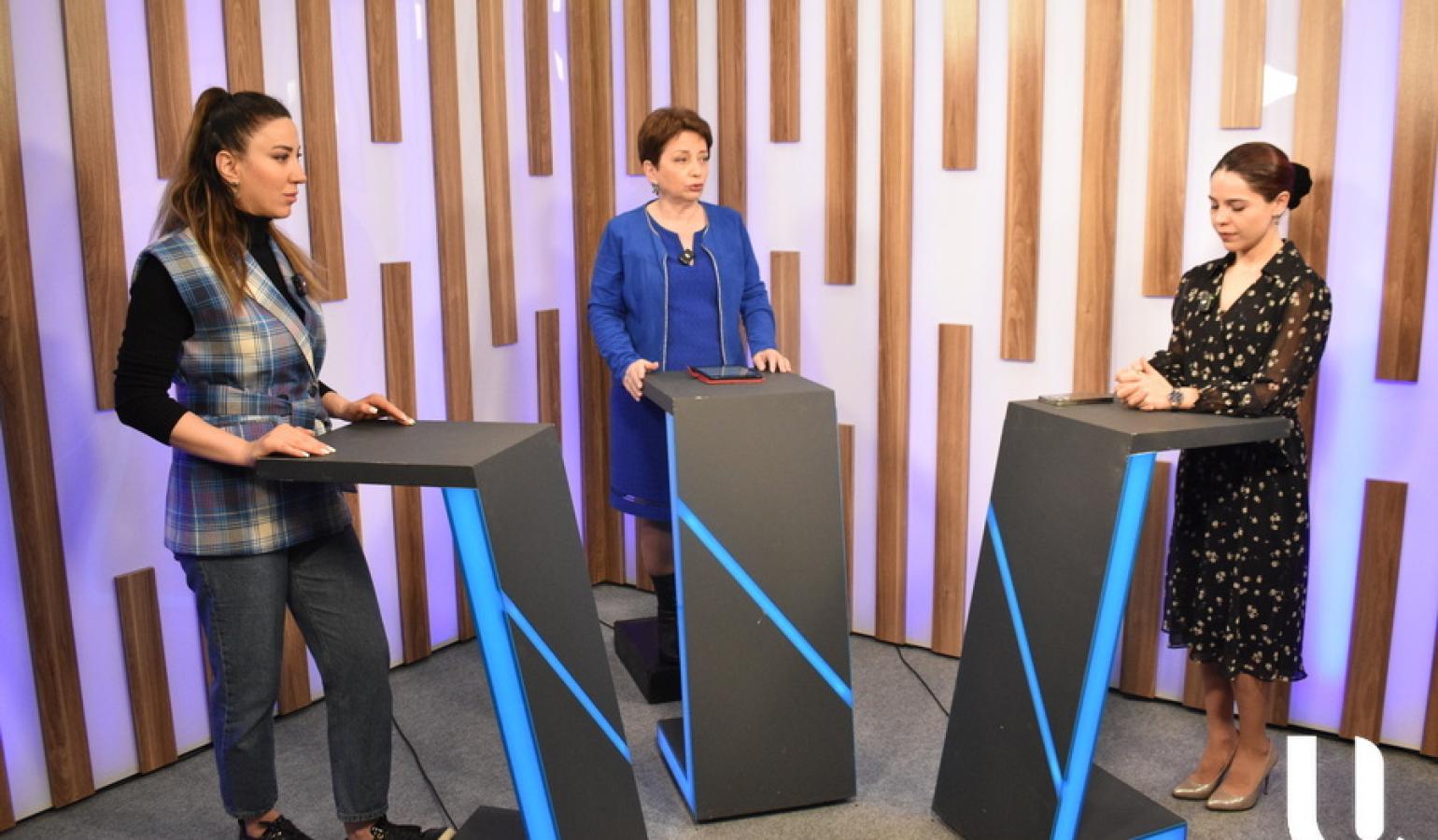
“Politics is wild, there are no balanced approaches here, and it is still the threat of force that brings solutions to maturity; the highest indicator of the level of peace is adherence to legal processes,” such an opinion was expressed on the air of Aravot’s “Areresum” program by Siranush Sahakyan, Director of the International and Comparative Law Center. The program also featured expert on Azerbaijani affairs Tatevik Hayrapetyan. The guests spoke about Armenian–Azerbaijani relations, the peace treaty, in this context Armenian prisoners, their expected fate, and the connections between Azerbaijan’s Human Rights Defender and the political elite.
Continuing the notion of the legal path to achieving peace, Siranush Sahakyan emphasized that if peace truly exists, then the issues of Armenian prisoners, which by their nature are easily solvable, should have been resolved. “If there is peace, it is at least inexplicable to me why unresolved issues should not receive regulation through international legal bodies. Why does the peace agreement require renunciation of interstate complaints, and if that renunciation occurs and the problems continue to remain unresolved, what new, civilized mechanisms are being proposed to resolve them?”
Speaking about the possible withdrawal of international legal acts for the sake of a peace agreement, Tatevik Hayrapetyan found it incomprehensible how, in parallel with this, a completely unlawful, closed, and internal process could be taking place in Baku without any clarification, coverage, or evidence, and be presented as a process against the Republic of Armenia.
She recalled that during the August 8, 2025 meeting, according to the circulated video, Trump addressed Pashinyan, saying that he was preparing to speak with Aliyev regarding the issue of 23 Christian Armenians. “Months have passed since that day, the logical question is: did Trump address Aliyev or not, and do the Armenian authorities continue to insist and say that it is important for them that Trump address the leader of Azerbaijan, when the overall situation in the region is quite tense, and that humanitarian step would only benefit the easing of tensions?”
After Ruben Vardanyan’s latest statement, in which he said that he was unable to establish contact with the Human Rights Defender of Azerbaijan, Azerbaijani media circulated a message stating that Sabina Aliyeva and members of the National Preventive Group of her staff had visited the institution where Armenian prisoners are being held, including Ruben Vardanyan. “The circumstances cited in the statement circulated about that visit are not verifiable for us; we simply have no alternative source. Secondly, the chosen ‘language’ was extremely cunning: it was stated that they visited a penitentiary institution, and in this case it is not at all clear to us whether the ombudsperson personally familiarized herself with the conditions, or whether the employees of the ombudsperson’s office merely had conversations with the head or staff of the penitentiary institution and reproduce those conversations in their reports,” said Siranush Sahakyan.
The human rights defender also added that one should approach Azerbaijan’s Human Rights Defender with reservations, and this has several reasons: after the expulsion of the Red Cross, Azerbaijan is trying to create the impression among the international community that there are domestic mechanisms protecting the rights of Armenians, and through this is also attempting to influence the positions of international courts. “Since in previous court cases we have reached the conclusion that although certain means of protection theoretically function in Azerbaijan, they are ineffective with regard to ethnic Armenians, they may seek international protection of their rights without exhausting domestic remedies. Now, in order for the authorities in Baku to shift the game exclusively to the domestic platform, they are trying to pretend that new, effective mechanisms are emerging in the country and cite their ombudsperson as such, and through these visits they present as if there is no obstacle, that a torture-prevention mechanism exists - it visits, listens to their problems, provides solutions, and so on.”
Siranush Sahakyan also spoke about the personal and other ties between the Azerbaijani Ombudsman and the political elite, noting that Aliyeva's husband is a member of the ruling political team, her father is an employee of the diplomatic corps, and her holding this position is precisely due to warm, family and personal ties with the Aliyevs. In addition, in the case of Azerbaijan, there is a clear international assessment that the Ombudsman does not operate independently of the executive branch.