
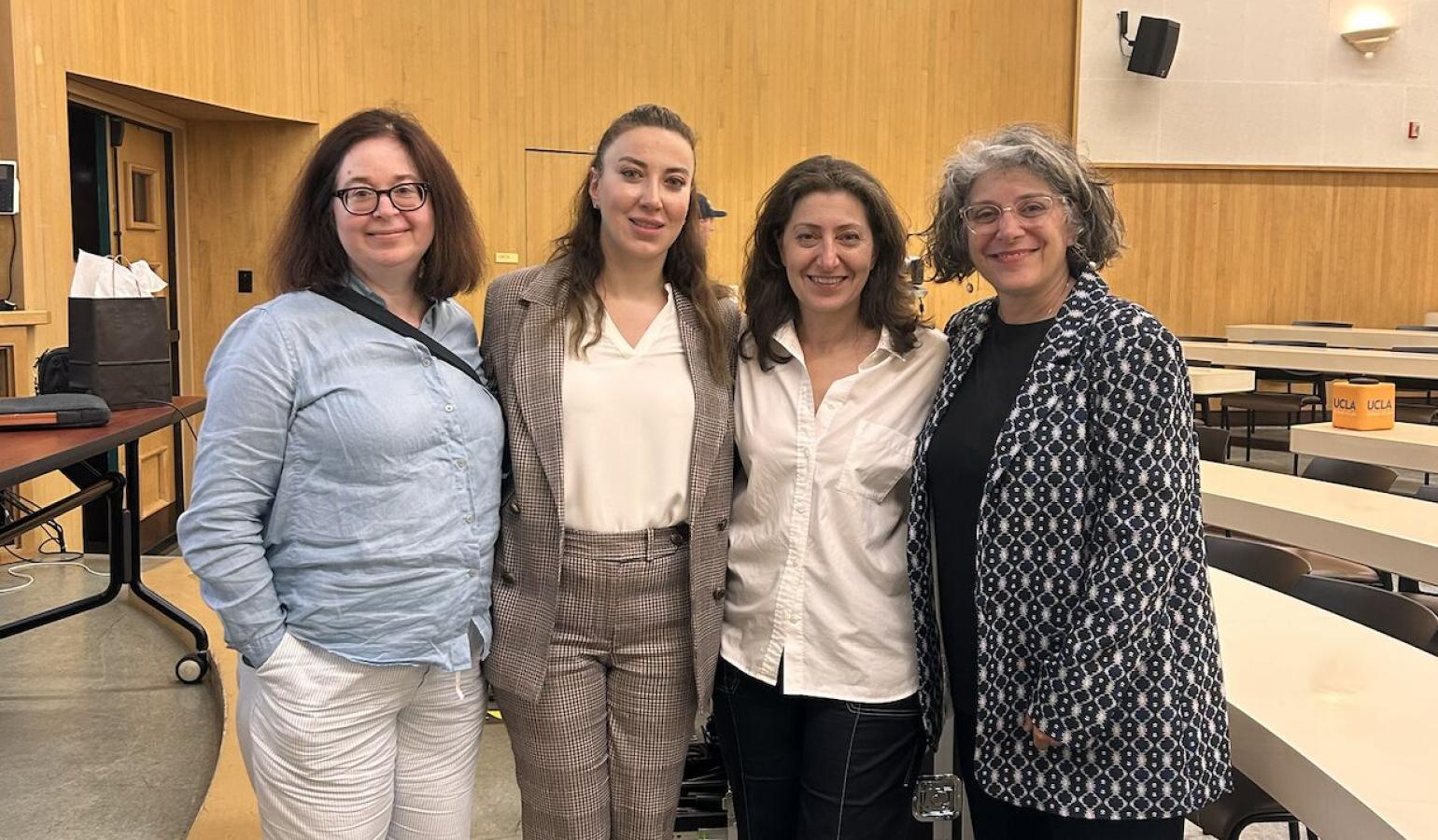
On September 24, Siranush Sahakyan, director of the International and Comparative Law Center, spoke at the UCLA School of Law as part of a discussion dedicated to the criminal trials conducted against Armenians in Baku. The discussion was organized by the Promise Institute for Human Rights at UCLA School of Law, in collaboration with the UCLA Promise Armenian Institute, the Armenian Bar Association, the Armenian Legal Center for Justice and Human Rights, the Armenian Law Students Association at UCLA School of Law, and the Western Region of the Armenian National Committee of America.
Siranush Sahakyan presented a legal analysis of the criminal cases initiated against Armenians in Azerbaijan following the 2023 war and the trials held in Baku, with particular attention to the cases involving representatives of the former military-political leadership of Artsakh.
One of the key questions of the discussion was whether a person can be held criminally liable solely because they held a position in an unrecognized state, if there is no evidence that they committed a specific criminal act.
Addressing the unrecognized status of the Republic of Artsakh, Sahakyan emphasized that, under international law, the non-recognition of a territory or political entity does not in itself mean that civil, administrative, or governmental activities carried out there can, by virtue of that fact, be considered criminal.
The discussion also addressed the limits of individual criminal responsibility, fair trial guarantees, and the legal grounds for the trials conducted against Armenians in Baku.
The event held at UCLA provided an opportunity to present the issue of Armenian captives and the criminal prosecutions conducted against them to international legal and academic circles, contributing to broader professional attention to the proceedings taking place in Baku.