
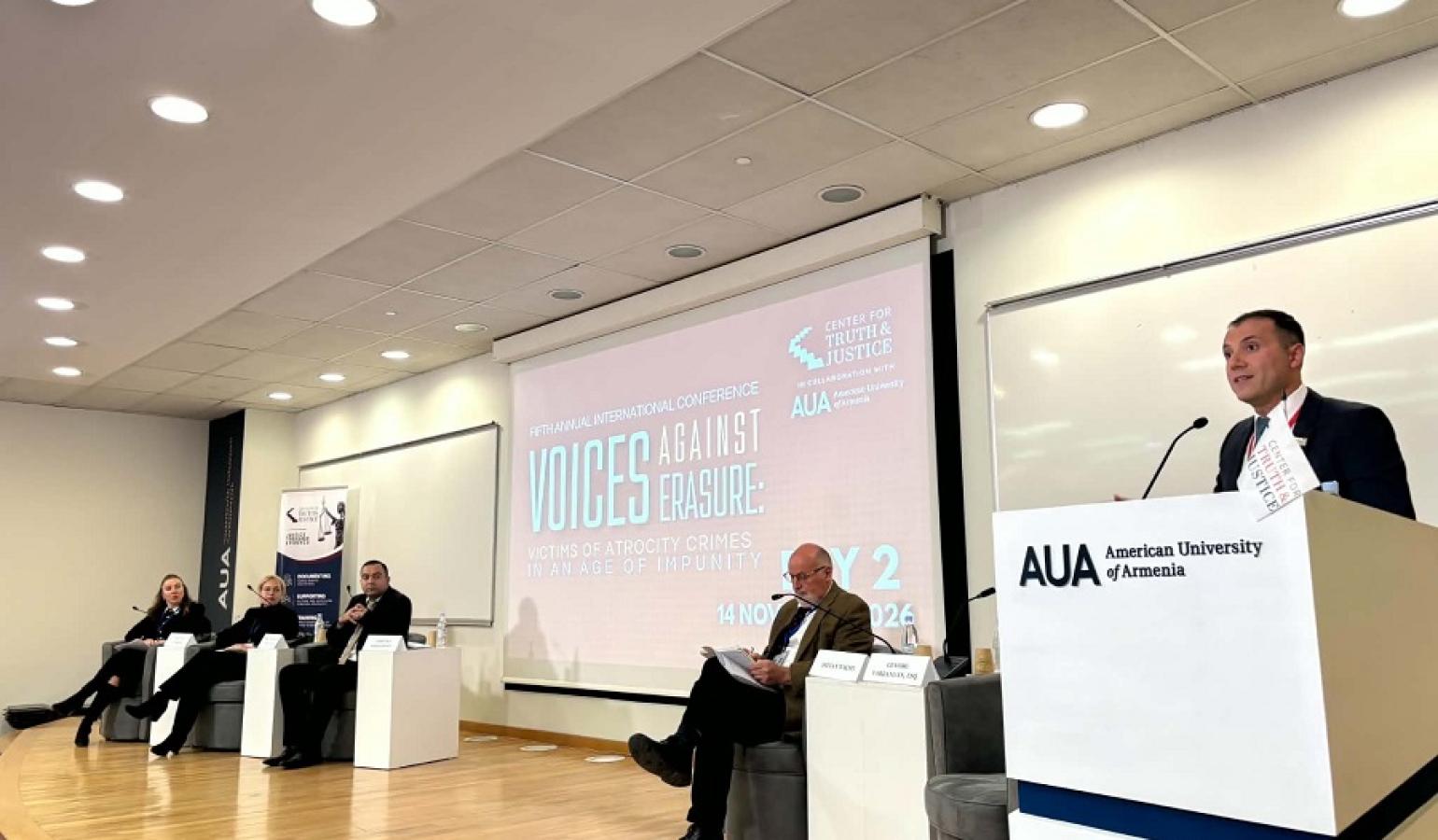
On November 14, Siranush Sahakyan, director of the International and Comparative Law Center, participated in the fifth annual international conference titled “Voices Against Erasure: Victims of Atrocity Crimes in an Age of Impunity” held at the American University of Armenia.
Sahakyan participated in the conference’s fourth panel discussion, titled “International Justice Amid Challenges.” Addressing the initialling of the peace agreement between Armenia and Azerbaijan, Sahakyan stated that peace and justice are interconnected: “We see that the peace agreement initialled between the Republic of Armenia and Azerbaijan contains no provisions concerning the consequences of the conflict. There is no provision regarding forcibly displaced persons, no attempt is made to address the issue of prisoners of war, or the cases in which people were forced to leave their territories, and there is no reference to enforced disappearances. Within these political processes, the concept of accountability is effectively marginalised and becomes the subject of some kind of transaction.”
During the conference, Sahakyan also informed the participants that the International and Comparative Law Center has 300 cases exposing Azerbaijan’s war crimes, as well as cases concerning property rights. With regard to the issue of withdrawing inter-state proceedings, Sahakyan said that she would like to see how the courts respond to this: “Expressing the intention to withdraw a claim is a procedural or litigation right, the extent to which it will be granted falls within the jurisdiction of the court. Here, it is not only the victim who is concerned, the impact goes far beyond the rights of the victim. The beneficiaries are not happy with the states’ withdrawal of these cases. We wrote letters to the courts on behalf of the victims, stating that they are interested in the administration of justice. We are waiting to see whether the courts will reject the withdrawal by applying the concept of the interests of justice to inter-state cases. We hope that the court will not allow political deals to be made at the expense of people's right to justice.”
The discussion also featured former international investigative judge Stefan Wespi, lawyer Christian Mkhitaryan, and Hilde Farthofer, associate professor at Friedrich-Alexander University of Erlangen-Nuremberg. The discussion was moderated by Gevorg Vardanyan, president of the Truth and Justice Center’s conference.
The conference was organised with the initiative of the Truth and Justice Center, in cooperation with the American University of Armenia. It was dedicated to the rights of victims of mass atrocities, the possibilities and limitations of international justice, ensuring accountability, and recognising victims’ experiences.